Why Healthcare Organizations Need More Than EDI to Connect Their Business Systems
- DataSync
- 17 Oct, 2026
- 03 Mins read
- Edi
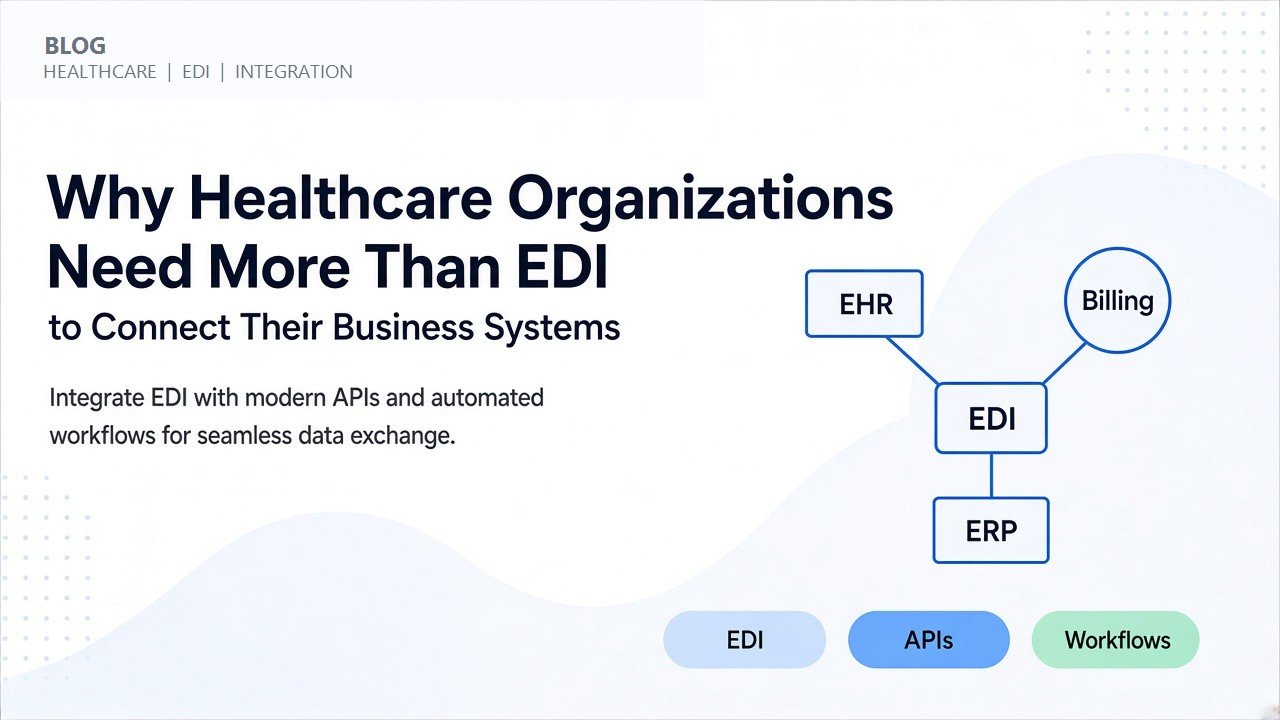
EDI is essential in healthcare, but it is not enough on its own to connect modern business systems. Transactions like 837, 835, 834, 270, and 271 move critical administrative data between partners. Inside the organization, however, care delivery, billing, finance, and operations still depend on broader integration.
Healthcare organizations need EDI plus the systems, workflows, and connectivity layers that make that data usable across the business.
What EDI Does Well
Healthcare EDI is highly effective for standardized partner exchange.
It supports:
- Claims submission and remittance
- Eligibility verification
- Enrollment and member maintenance
- Claim status inquiries and responses
- Consistent B2B document exchange with payers and clearinghouses
For external administrative interoperability, EDI remains a core requirement.
Where EDI Alone Falls Short
EDI moves documents between organizations. It does not automatically solve internal system connectivity.
Common gaps include:
- EHR or practice systems that do not sync cleanly with billing
- Remittance files that arrive but are hard to post
- Enrollment updates that do not reach every downstream system
- Limited real-time visibility across claim and payment workflows
- Manual handoffs between operations, finance, and support teams
When those gaps remain, EDI success on paper can still mean operational friction in practice.
The Systems Healthcare Organizations Must Connect
A modern healthcare environment usually includes more than a single EDI channel.
Teams often need connections across:
- EHR and clinical systems
- Practice management and billing platforms
- Clearinghouses and payer gateways
- Finance and ERP systems
- Eligibility and enrollment tools
- Reporting, audit, and exception-management workflows
EDI is one transport and document standard within that broader architecture.
What “More Than EDI” Usually Means
Healthcare organizations typically need additional capabilities around EDI, not a replacement for it.
That often includes:
- APIs and application integrations for internal systems
- Workflow automation for exceptions and approvals
- Real-time monitoring and alerting
- Master data alignment for providers, members, and payers
- Dashboards that connect submission, status, and remittance outcomes
- Secure identity, access, and audit controls across platforms
These layers turn EDI transactions into connected business operations.
Why This Matters for Revenue Cycle and Operations
When healthcare organizations rely on EDI files alone, teams can lose context between steps.
With broader connectivity, they can:
- Confirm eligibility before claim creation
- Track claims from submission through remittance
- Reduce duplicate manual entry across systems
- Spot failures before they become denials or delays
- Give finance and operations a shared source of truth
That is the difference between exchanging documents and running connected processes.
A Practical Integration Mindset
The strongest healthcare programs treat EDI as a foundation, not the full solution.
They ask:
- Can each transaction reach the right internal system?
- Can staff see status without checking multiple portals?
- Can exceptions be routed to the right owner quickly?
- Can enrollment, eligibility, claims, and payment data stay aligned?
If the answer is no, the organization needs more than EDI connectivity alone.
Final Takeaway
Healthcare organizations need more than EDI to connect their business systems. EDI remains critical for payer and partner exchange, but internal integration, workflow automation, and operational visibility are what make eligibility, enrollment, claims, and remittance work as one process.
Teams that combine EDI with broader system connectivity reduce manual work, improve revenue cycle control, and build a more resilient healthcare operations stack.
Our Team Members