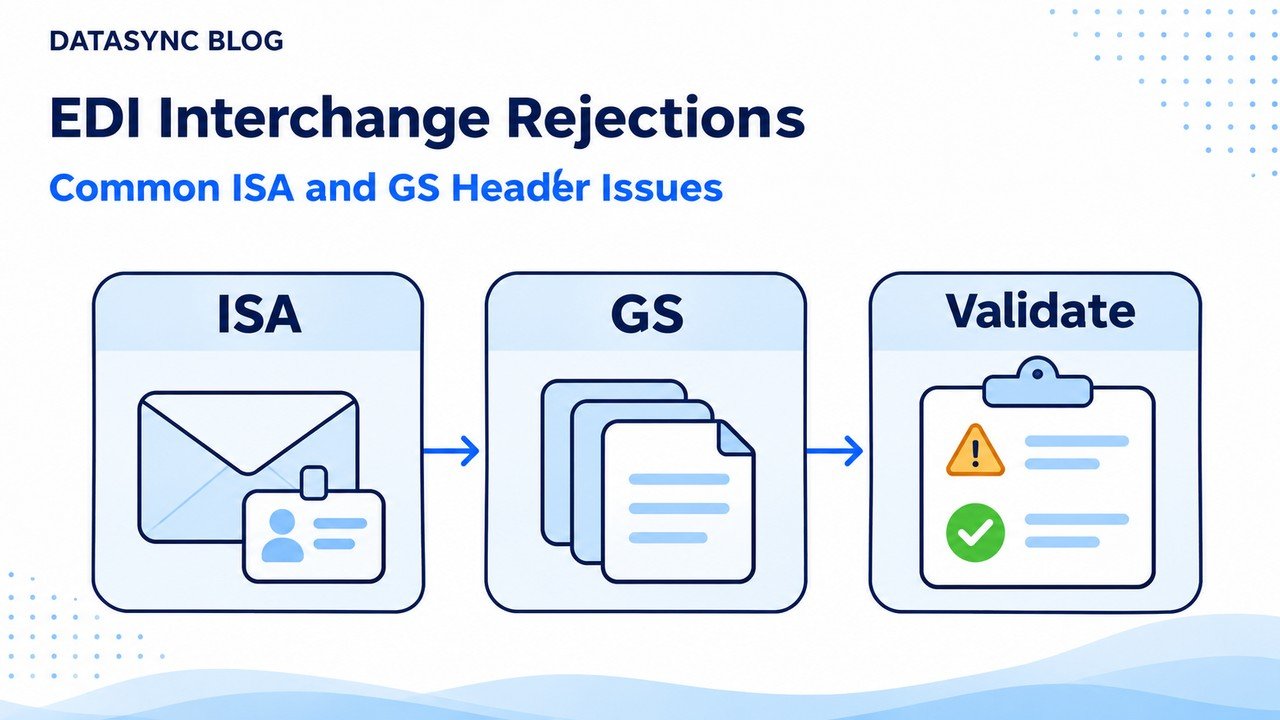
Why EDI Interchanges Get Rejected: Common ISA and GS Header Issues
- DataSync
- 11 Nov, 2026
- 03 Mins read
- Edi
EDI interchange rejections happen when a receiver cannot accept the envelope surrounding an X12 exchange. A valid invoice or purchase order can still fail because the sender identity, delimiters, version, or control structure does not match the receiving system’s expectations.
The fastest investigation starts with the rejection evidence and the original envelope, before changing the business-document map.
What Counts as an Envelope Rejection
The ISA and GS headers identify the exchange and its functional groups. Receivers use those details to recognize the partner relationship and select processing rules.
An investigation should collect:
- The original payload exactly as transmitted
- Sender and receiver IDs with their qualifiers
- Test or production environment
- ISA13 and GS06 control numbers
- The partner’s acknowledgment or rejection log
- The applicable implementation guide and agreement
Keep the failure layer clear. An interchange rejection, a rejected functional group, and a business-rule rejection can require different corrections.
Three Header Checks That Matter
Partner Identity and Environment
Check ISA05 through ISA08 against the agreed interchange qualifiers and IDs. Then check the GS application sender and receiver codes separately. These identifiers serve different layers. Confirm that ISA15 identifies the intended test or production environment and that the message reached the corresponding endpoint.
Separators, Padding, and Versions
Inspect the raw ISA rather than a reformatted log entry. Its fixed-width fields and separator positions matter. Check ISA12 and GS08 against the configured envelope and transaction versions. A text editor or export process that trims padding can change what the parser sees.
Control Numbers and Closing Trailers
Compare ISA13 with IEA02 and GS06 with GE02. Also check the group and transaction counts. Reused control numbers can trigger duplicate checks even when header and trailer values match. These envelope relationships are documented in ediFabric’s X12 control segment guide.
Signals the Header Needs Attention
Move envelope checks to the front of the investigation when:
- The receiver cannot identify the trading partner
- The same map works for one environment but fails in another
- Rejection starts immediately after a partner configuration change
- The parser fails before reaching the transaction body
- Several document types fail in the same transmission
- Previously successful files fail after being retransmitted
A delivery receipt only establishes evidence about transport. It does not establish that the X12 envelope passed validation.
How to Investigate Without Creating More Duplicates
Use a controlled correction path:
- Preserve the failed payload, timestamps, and transmission reference
- Identify whether the rejection applies to the interchange, group, or transaction
- Read the acknowledgment status and error details alongside receiver logs
- Compare the relevant header fields with the agreed partner configuration
- Validate a corrected sample through the partner’s test process
- Confirm retransmission rules and prior processing before resending production data
A TA1 can report interchange issues such as invalid separators or duplicate interchange control numbers. Group and transaction feedback commonly uses a 997 or 999. Availability and rejection behavior depend on the platform and agreement; Microsoft’s TA1 documentation shows both the codes and implementation-specific behavior.
What Reliable Envelope Validation Should Mean
Build prevention into onboarding and operations:
- Versioned partner profiles with clear owners
- Validation of raw envelopes before transmission
- Persistent, coordinated control-number allocation
- Separate test and production settings
- Searchable acknowledgment references
- Regression samples for each supported partner version
Keep the profile, payload, and acknowledgment together when documenting a fix. That makes a later configuration regression easier to recognize.
A Simple Header Readiness Test
Ask four questions before promoting a partner connection:
- Do both sides agree on interchange and application IDs?
- Does the raw ISA retain its expected padding and separators?
- Do header control numbers and counts match their trailers?
- Can operations identify the rejected layer from the available evidence?
An unanswered question is a useful test case to resolve before live traffic depends on the connection.
Final Takeaway
ISA and GS header problems can stop an exchange before its business content is usable. Check partner identity, envelope formatting, versions, and control structures against the original payload.
A clear diagnosis makes the correction smaller and the retransmission easier to control.
Our Team Members