Why AS2 MDN Validation Fails: Understanding MIC Mismatches and Signature Errors
- DataSync
- 13 Nov, 2026
- 03 Mins read
- Edi
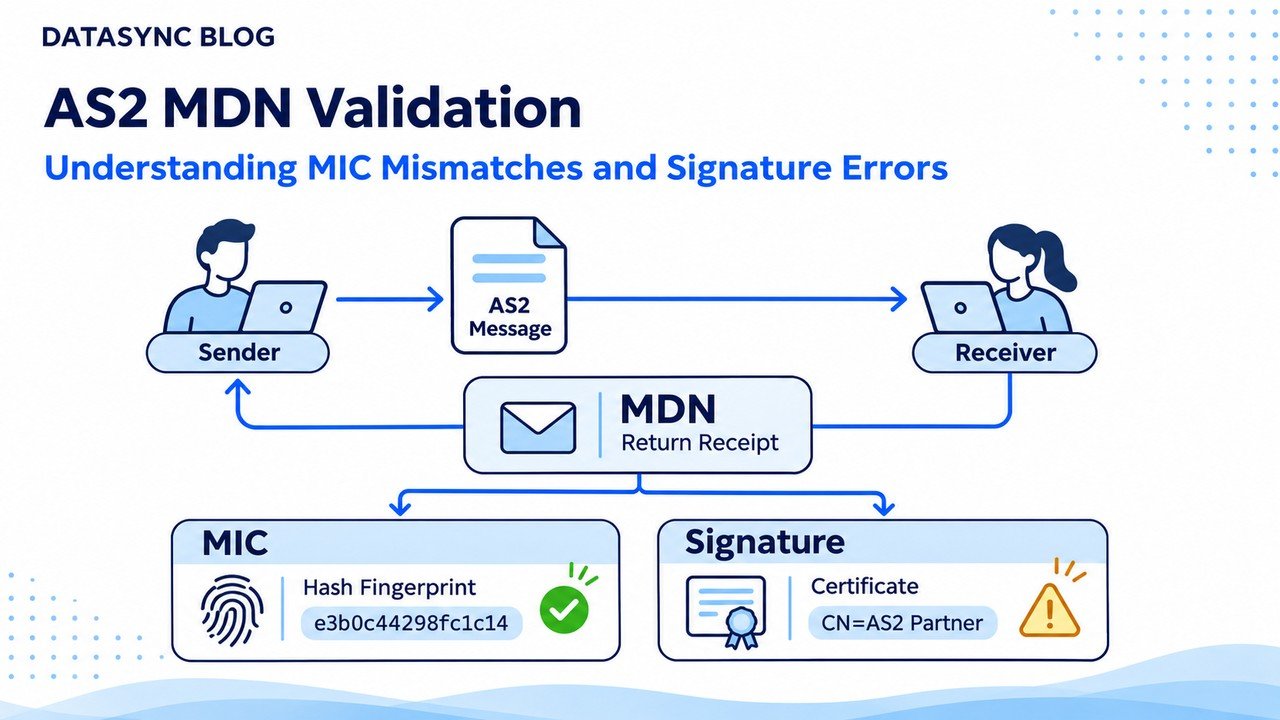
AS2 MDN validation failures mean the sender cannot establish the expected receipt evidence for an exchange. A returned receipt may refer to the wrong message, contain an unexpected message integrity check, or fail signature verification.
The first task is to identify which check failed. Receiving an MDN and successfully validating it are separate outcomes.
What Counts as a Validated MDN
A Message Disposition Notification reports the receiving AS2 system’s disposition of a message. When a signed receipt is required, the sender must also verify the receipt’s signature and applicable integrity evidence.
Keep these records together:
- The original AS2 Message-ID
- Original-Message-ID from the receipt
- The raw MDN and its disposition details
- The stored outbound MIC and returned MIC
- The algorithm associated with each MIC
- The partner certificate used for receipt verification
Receipt validation supports delivery evidence. It does not establish that an ERP accepted the invoice or that a purchase order passed business checks.
Three Checks Behind MDN Validation
Message Correlation
Match Original-Message-ID to the original outbound Message-ID. A delayed asynchronous receipt or incorrect message association can produce a misleading failure. Investigate the matching record before comparing the receipt with whichever transmission happens to be newest.
MIC Comparison
The Message Integrity Check represents specific message content according to the AS2 packaging rules. Compare the returned value and algorithm with the values stored for that outbound exchange. MIME canonicalization and the signed or unsigned form affect which bytes are covered; hashing an exported business file can therefore be the wrong comparison. RFC 4130 defines these receipt and content rules.
Signature Verification
For a signed MDN, verify the signature using the partner’s appropriate public certificate and the platform’s validation rules. An outdated certificate, incorrect partner association, or altered signed content needs a different correction from a MIC mismatch. Microsoft’s incoming MDN processing documentation describes signature verification and comparison against stored outbound MIC values as separate steps.
Signals the Receipt Needs Investigation
Review receipt evidence when:
- An MDN arrives but the exchange remains unconfirmed
- Original-Message-ID does not match the outbound record
- The returned MIC differs from the stored value
- The expected signed receipt arrives unsigned
- Signature failures start after certificate rotation
- Only asynchronous receipts fail or arrive late
Also read the disposition itself. A correctly signed receipt can report a processing error; a valid signature does not turn an error disposition into success.
How to Investigate Without Weakening Validation
Use a repeatable sequence:
- Preserve the original outbound record and raw receipt
- Confirm that the receipt belongs to the correct Message-ID
- Read the disposition and detailed error information
- Compare MIC values, algorithms, and the content stage used for calculation
- Check the receipt signing certificate and current partner agreement
- Reproduce the issue in testing and reconcile receiver processing before resending
Do not resolve a production failure by simply accepting an unsigned receipt or bypassing integrity checks. Correct the partner configuration or processing behavior responsible for the mismatch.
What Reliable Receipt Handling Should Mean
The integration should provide:
- Persistent outbound MIC and Message-ID records
- Independent statuses for receipt arrival and validation
- Certificate rotation history tied to partner profiles
- Consistent MIME handling across sending components
- Searchable synchronous and asynchronous receipt logs
- A process for unresolved or contradictory delivery evidence
Keep current algorithm choices aligned with both partners’ supported security settings. Older examples in protocol documentation are not a reason to downgrade an established configuration.
A Simple Receipt Validation Test
Ask four questions about a recent exchange:
- Can we retrieve the exact receipt and original message record?
- Does the receipt identify the expected outbound Message-ID?
- Can we explain both the MIC and signature validation results?
- Does the disposition agree with the exchange status shown to operations?
If these checks disagree, retain the uncertainty explicitly until the evidence is reconciled.
Final Takeaway
MIC comparison, signature verification, and message correlation answer different questions. Check each one when MDN validation fails.
A reliable receipt process preserves the evidence needed to explain both successful deliveries and uncertain outcomes.
Our Team Members