What Is B2B Integration Middleware and Why Do Enterprises Need It?
- DataSync
- 21 Oct, 2026
- 03 Mins read
- Edi
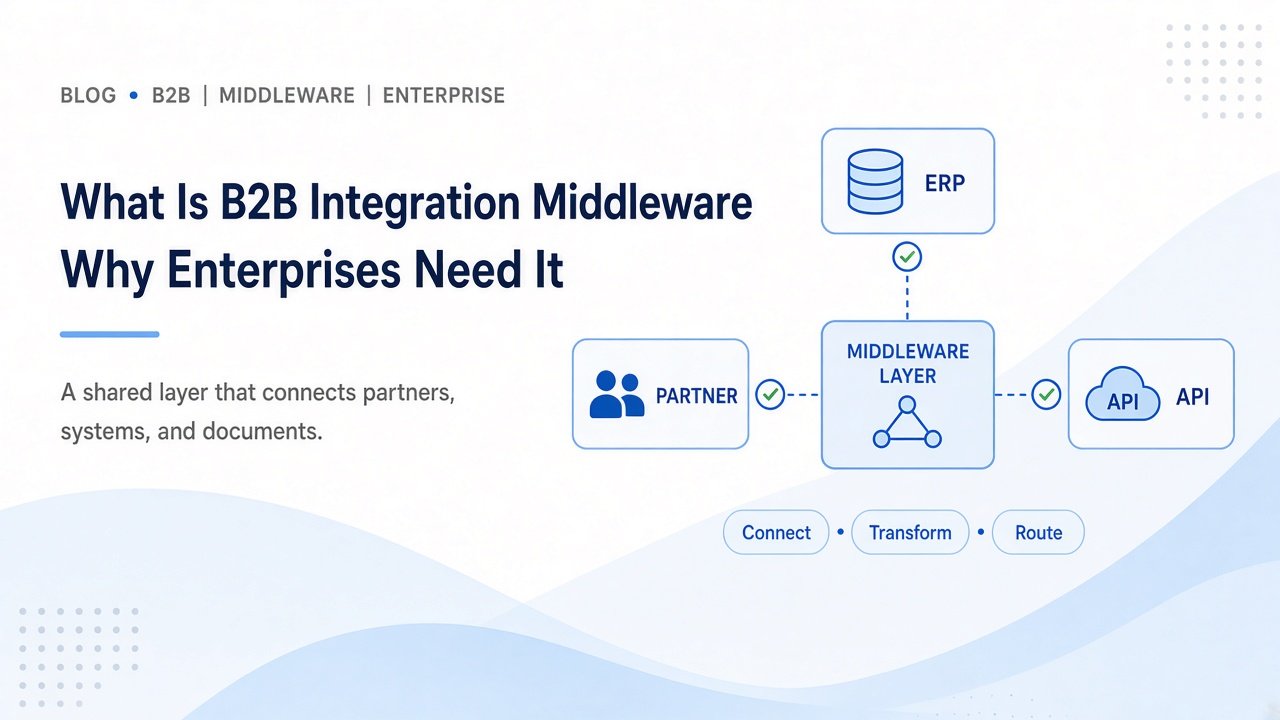
B2B integration middleware is the shared layer that connects an enterprise to trading partners and internal systems. It sits between ERPs, partner endpoints, and business applications so documents and events can be received, validated, transformed, and delivered without every system building its own connection.
Enterprises need that layer once partner volume, document types, and operational risk outgrow one-off integrations.
What B2B Integration Middleware Does
Middleware is not the business system and it is not the partner’s system. It is the controlled path between them.
A typical middleware layer handles:
- Connectivity across AS2, SFTP, APIs, and other channels
- Document intake and partner identification
- Validation against expected structure and business rules
- Transformation between partner formats and internal formats
- Routing to the right application or outbound endpoint
- Tracking, retries, and exception visibility
That is the work EDI and B2B teams repeat for every partner. Middleware is how that work becomes a platform instead of a pile of scripts.
Why Direct Connections Stop Being Enough
Early integrations often live inside the application that needs the data. Finance builds an invoice feed. Logistics builds a shipment feed. IT builds a custom partner folder.
Each one can succeed on its own. Together they create duplicated maps, uneven security, and no single view of what failed.
Middleware exists so those concerns are handled once and reused.
Why Enterprises Depend on It
Partner scale
A handful of partners can be managed manually. Dozens or hundreds cannot. Middleware gives each partner a configuration, not a new project from scratch.
Format differences
Trading partners rarely send the same layout. Middleware absorbs X12, XML, CSV, JSON, and partner-specific variants so core systems stay stable.
Operational control
Enterprises need to know whether a document was received, rejected, or delivered. Middleware is where that status belongs, because the applications on either side only see their own step.
Change isolation
When a partner rotates a certificate, changes a map, or adds a transaction type, the update can stay in the integration layer instead of rippling through every business system.
What Middleware Does Not Replace
Middleware does not replace the ERP, the warehouse system, or the partner agreement. It also does not remove the need for clear business rules.
It succeeds when ownership is clear:
- Business teams define what a valid order, invoice, or claim means
- Integration teams configure connectivity, maps, and routes
- Operations teams monitor exceptions and partner performance
Without that split, middleware becomes another black box.
Signs an Enterprise Needs B2B Middleware
The need is usually obvious when teams start saying:
- Every new partner takes as long as the last one
- The same mapping logic is copied in several places
- Failures are found by customers before internal monitoring
- Security and certificate work is scattered across servers
- No one can trace a document from receipt to the business system
Those are architecture problems, not one-off bugs.
Final Takeaway
B2B integration middleware is the shared layer enterprises use to connect partners and internal systems without rebuilding every link. It scales partner onboarding, isolates change, and gives operations a single place to see delivery and failure.
Enterprises need it when B2B exchange is no longer a side project and has become part of how orders, invoices, shipments, and other business documents actually move.
Our Team Members