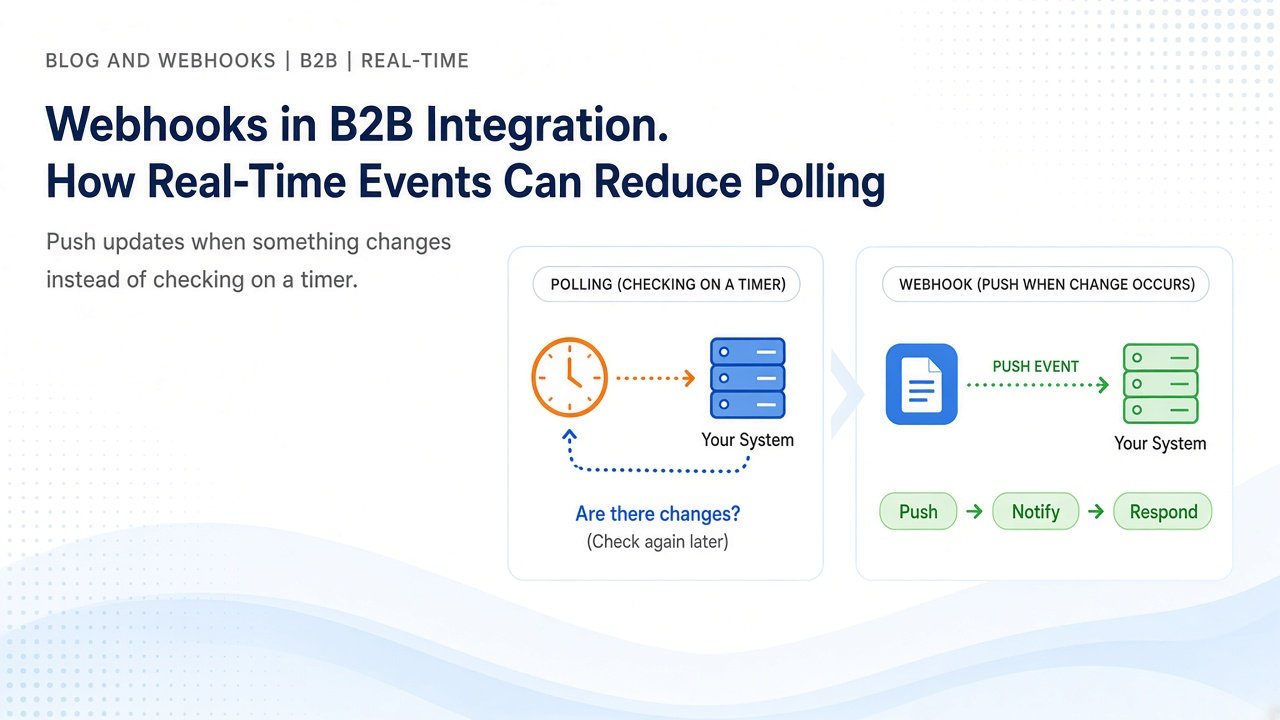
Webhooks in B2B Integration: How Real-Time Events Can Reduce Polling
- DataSync
- 23 Oct, 2026
- 03 Mins read
- Edi
Webhooks let one system notify another the moment something changes. Instead of asking “is there anything new?” on a timer, the sender pushes an event to a callback URL. In B2B integration, that shift can cut polling traffic and shorten the time between a business event and the next action.
Polling still has a place. Webhooks are the better fit when partners or internal systems can accept a real-time push.
What Polling Costs in B2B Flows
Polling means a client repeatedly checks an API, mailbox, or folder for new data.
It is simple, and it works when volumes are low. At scale it creates:
- Repeated calls that usually return nothing
- Delay equal to the polling interval
- Extra load on both sides
- Harder capacity planning during peak hours
Teams often shorten the interval to feel more real-time, which multiplies the empty checks.
How Webhooks Change the Pattern
With a webhook, the system that owns the event calls the receiver when the event happens.
A partner might notify you that:
- An order status changed
- A document is ready for pickup
- A payment posted
- A validation failed
Your integration layer receives that notice and starts mapping, routing, or exception handling immediately. The receiver does not spend the day asking whether work exists.
Where Webhooks Reduce Polling
Webhooks help most when the event is small and time-sensitive, and the receiver has a stable endpoint.
Good fits include:
- Status updates after an EDI document is accepted or rejected
- Partner notifications that a file is available
- Internal callbacks from an ERP or billing system
- Exception alerts that should reach operations at once
They are a weaker default when the partner can only drop files on a schedule, or when the payload itself is a large document better sent over AS2 or SFTP. In those cases a webhook can still announce that the document is ready, while the file moves on the existing channel.
What Reliable Webhook Integration Requires
A webhook is only useful if the receiver can trust it and recover when it fails.
Operations teams should plan for:
- Authentication so only the expected sender can call the endpoint
- Signature or secret checks on each request
- Fast acknowledgment, with heavier processing done after the response
- Retries when the receiver is briefly unavailable
- Idempotency so a repeated event does not create a duplicate transaction
- A fallback poll or replay path when a notification is missed
Without those controls, teams trade quiet polling for noisy, untraceable callbacks.
Polling and Webhooks Can Coexist
Many B2B programs keep a slow reconciliation poll even after webhooks are live. The webhook carries the real-time path. The poll catches anything the callback missed.
That combination is often more dependable than deleting polling entirely on day one.
Final Takeaway
Webhooks reduce polling by pushing real-time events instead of asking for changes on a timer. In B2B integration they shorten reaction time for status, exceptions, and document-ready notices.
They stay reliable only when authentication, retries, duplicate protection, and a recovery path are part of the design. Used that way, webhooks make partner and system updates faster without giving up operational control.
Our Team Members