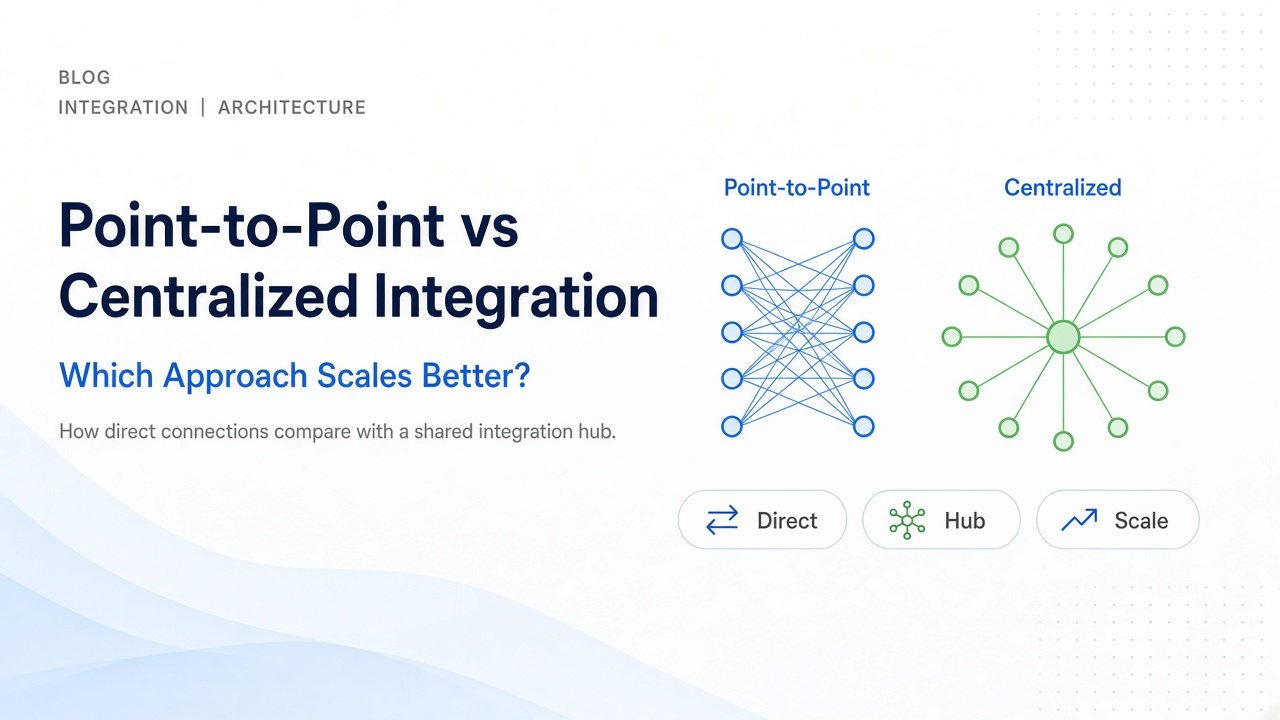
Point-to-Point Integration vs Centralized Integration: Which Approach Scales Better?
- DataSync
- 19 Oct, 2026
- 03 Mins read
- Edi
Point-to-point integration connects systems directly. Centralized integration routes those connections through a shared hub. Both can move data, but they scale very differently once partners, documents, and internal systems multiply.
For EDI and B2B teams, the question is not which diagram looks simpler. It is which model still works when the next trading partner, ERP change, or exception workflow arrives.
What Point-to-Point Integration Means
In a point-to-point model, each system talks directly to each other system.
A billing platform might send claims straight to one payer gateway. An ERP might drop purchase orders straight into a partner SFTP folder. A warehouse system might call a carrier API on its own.
That works when the landscape is small. Each link is easy to explain, and teams can stand it up quickly.
The cost shows up later. Every new partner or system adds another custom connection, another set of credentials, and another place where mapping, retries, and monitoring must be rebuilt.
What Centralized Integration Means
A centralized model places a shared integration layer between systems and partners.
Applications send and receive through that layer. The hub handles routing, transformation, protocol differences, and operational visibility. Individual systems no longer need a private connection for every relationship.
This is the model most growing EDI and B2B programs move toward once partner volume and document variety increase.
How the Two Approaches Compare
Connection growth
Point-to-point connections grow fast. Ten systems that all need to talk can require dozens of links. A hub keeps each system connected once, then manages relationships in one place.
Change management
When a partner changes a map, endpoint, or certificate, point-to-point teams often hunt through several custom flows. A centralized layer localizes that change.
Visibility
Direct links scatter status across inboxes, scripts, and application logs. A hub can show receipt, validation, delivery, and failure in one operational view.
Speed of the first connection
Point-to-point is often faster for a single, well-understood flow. Centralized integration takes more design up front and pays that cost back as volume grows.
Which Approach Scales Better?
Centralized integration scales better for enterprises that expect more partners, more document types, and more internal systems over time.
Point-to-point can still be the right choice for a narrow, stable exchange with one or two endpoints. It becomes fragile when every new relationship copies the last custom build.
Teams usually feel the limit when:
- The same transformation logic exists in several places
- Failures are discovered by partners instead of monitoring
- Onboarding a new partner takes as long as the first one
- Certificate, endpoint, or map changes require coordinated edits across many flows
A Practical Way to Decide
Ask three questions before adding the next connection:
- Will this pattern be repeated for more partners or systems?
- Do operations need one place to see status and exceptions?
- Will a change in one partner force edits in multiple applications?
If the answer is yes, a centralized integration approach will hold up better than another direct link.
Final Takeaway
Point-to-point integration is simple at the start. Centralized integration is simpler to run as the network grows. Enterprises that expect ongoing partner and system change scale more reliably when routing, transformation, and monitoring live in one integration layer instead of in a web of one-off connections.
Our Team Members