Pharmaceutical Supply Chain Traceability: Connecting EPCIS Events With Enterprise Integration
- DataSync
- 21 Nov, 2026
- 03 Mins read
- Edi
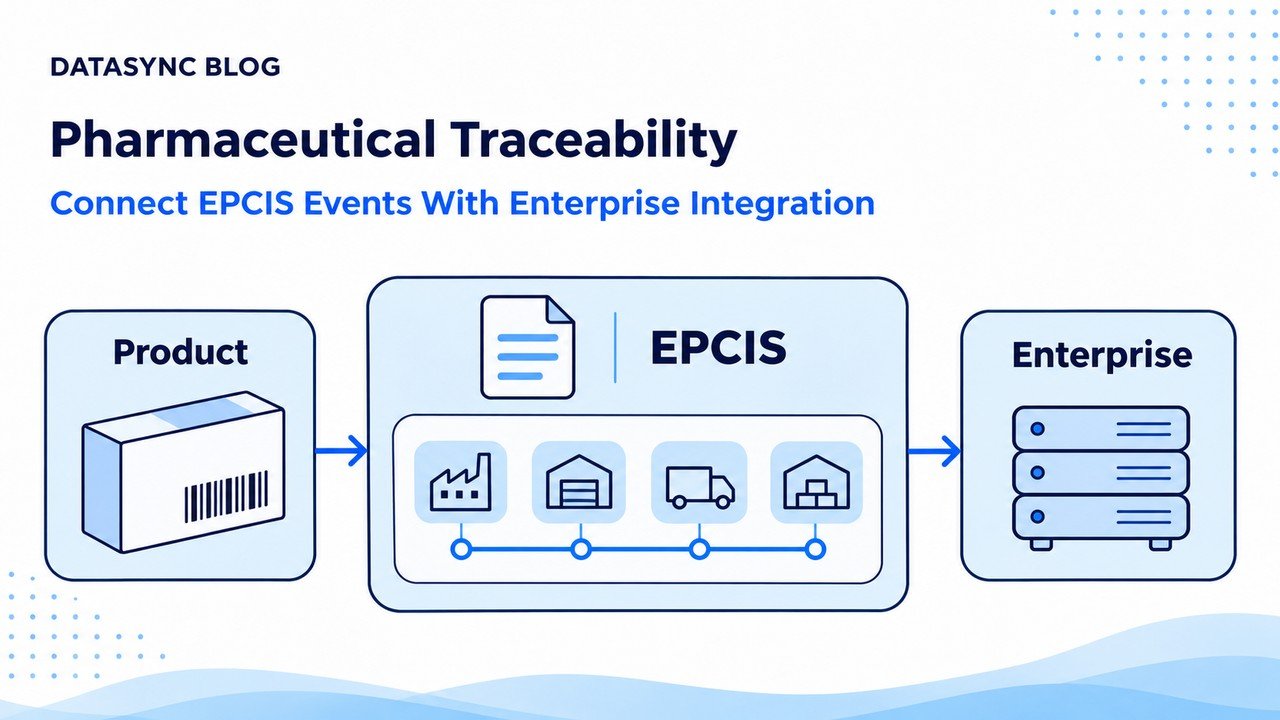
Pharmaceutical supply chain traceability depends on connecting product events with the systems that manage manufacturing, warehousing, and distribution. A traceability message becomes useful when a team can relate the identified products to the business activity that generated it.
EPCIS supplies a shared event model. Enterprise integration connects that model to operational records and the exceptions people must resolve.
What Counts as an EPCIS Event
EPCIS is a GS1 standard for creating and sharing visibility event data across applications and organizations. Its model represents observations in business context; the GS1 EPCIS standard defines event structures and capture and query interfaces.
An integration design should establish:
- Product and serialized-object identifiers
- Locations and reporting-party identities
- Event time, time-zone context, and recording time
- Business steps and dispositions
- Relevant business-transaction references
- The source system and responsible event owner
Agree the EPCIS version and industry implementation guidance with each partner. This article focuses on integration design; the required data and workflows depend on the applicable trading relationship.
Three Connections That Make Events Useful
Products and Enterprise Master Data
Resolve product identifiers to the catalog used by the enterprise. Keep serialized identity where the process requires it instead of reducing every observation to a product-level quantity. Unknown identifiers should be visible exceptions with an owner.
Events and Physical Operations
Connect capture to the actual warehouse or production activity. A packing observation and a shipping observation describe different points in the process. Document which application supplies each event and how the integration detects missing or delayed capture.
Packaging Relationships and Business Records
Preserve parent-child packaging relationships when the process uses aggregation. Link relevant events to shipment or other enterprise references using the agreed conventions. The integration should allow an operator to investigate the physical objects involved without guessing from a file name.
Signals Traceability Integration Has Gaps
Review the event pipeline when:
- Events contain products that master data cannot resolve
- Warehouse activity exists without corresponding event evidence
- Delayed events appear in misleading chronological order
- Packaging relationships are missing after repacking
- Partners reject events without a searchable exception
- Teams cannot connect an event to the originating operation
A successfully captured event does not by itself prove that every expected event in a product’s history is present.
How to Connect EPCIS With Enterprise Systems
Use a defined event-processing path:
- Identify the business operation and responsible capture system
- Resolve product, location, and party identifiers
- Validate the event against the agreed schema and business conventions
- Preserve event identity, timestamps, relationships, and provenance
- Deliver through the agreed interface and record the processing outcome
- Reconcile missing, duplicated, or rejected events with operational records
For example, a warehouse shipping a pallet needs to preserve the relevant relationship between that pallet and its contents. A shipping record that retains only the product quantity may be insufficient for the intended serialized investigation.
What Reliable Event Integration Should Mean
A practical design should include:
- Governed product and location identifiers
- Durable capture and delivery tracking
- Explicit treatment of duplicate and late events
- Authorized access to event capture and queries
- A defined process for correcting erroneous event assertions
- Reconciliation between physical activity and reported events
Preserve the history needed to explain a correction. Quietly overwriting source evidence can make later investigations harder even if a dashboard appears consistent afterward.
A Simple Traceability Test
Ask four questions about a selected product movement:
- Can we identify the products and locations involved?
- Can we retrieve the relevant event context and timing?
- Can we connect the events to enterprise operational records?
- Can we identify missing evidence and the team responsible for resolving it?
A demonstration should use an actual supported workflow, including at least one exception, rather than only a successful sample payload.
Final Takeaway
EPCIS creates a common way to share visibility events. Enterprise integration makes those events usable by connecting identifiers, physical operations, and business records.
Trustworthy traceability requires both a valid event message and a process for explaining gaps in the history.
Our Team Members