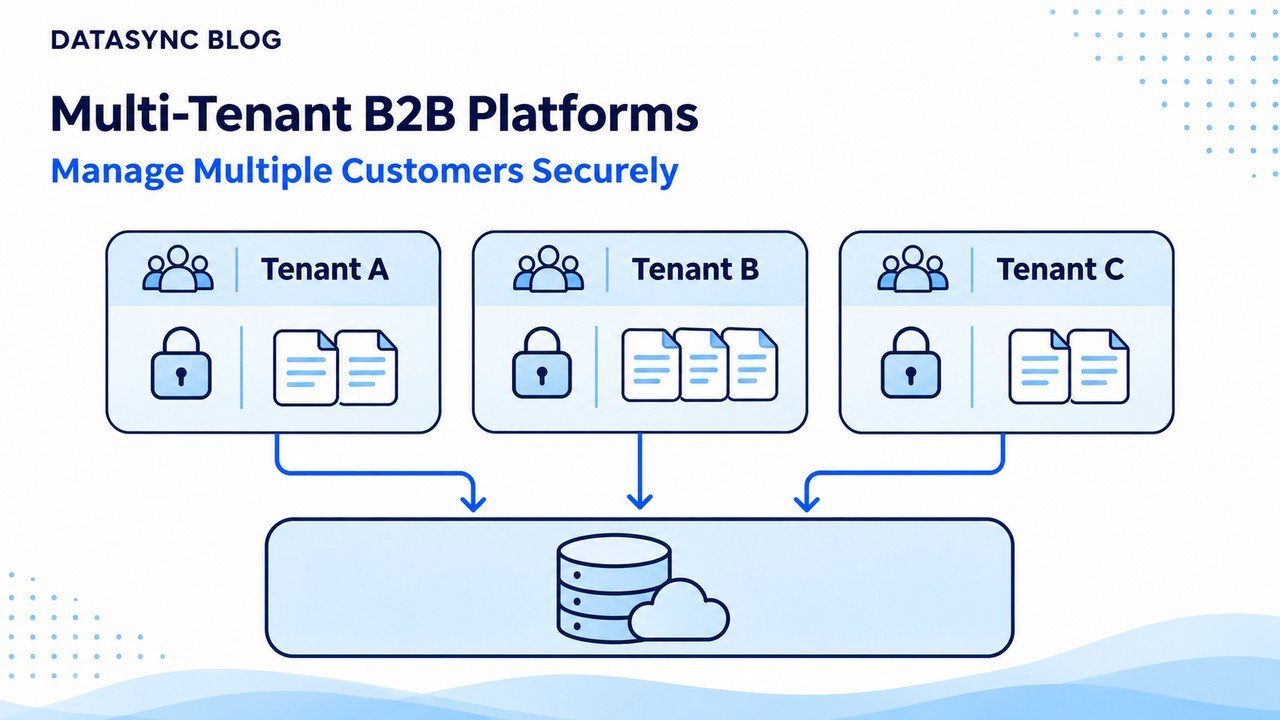
Multi-Tenant B2B Integration Platforms: Managing Multiple Customers Securely
- DataSync
- 26 Nov, 2026
- 03 Mins read
- Edi
Multi-tenant B2B integration platforms serve several customer organizations through some shared platform capabilities. The design needs to preserve each customer’s boundaries while processing documents, managing partners, and supporting operations.
A tenant boundary must remain effective beyond the user interface, including queues, storage, exports, and support tools.
What Counts as a Tenant Boundary
A tenant usually represents a customer organization with its own authorized users, partner relationships, and data. Isolation can combine shared and dedicated resources. Microsoft’s tenancy-model guidance describes isolation as a spectrum rather than one fixed architecture.
Identify which resources belong to each tenant:
- Users, service accounts, and API credentials
- Partner profiles and communication endpoints
- Maps, validation rules, and reference data
- Payloads, acknowledgments, and processing history
- Queues, scheduled jobs, and outbound notifications
- Exports, retention settings, and recovery records
Two customers can use the same external partner identifier. Partner IDs alone should therefore not determine which customer’s configuration or documents a request can access.
Three Isolation Layers to Design
Identity and Authorization
Establish tenant context through authenticated identity and authorized membership. Validate access to the requested tenant and resource at each relevant operation. A tenant identifier supplied in a request is not, by itself, proof that the caller belongs to that tenant.
Data and Configuration
Scope reads and writes for payloads, partner settings, maps, and search indexes. Shared storage requires controls appropriate to its design; dedicated databases also need correct routing and permissions. Microsoft’s multitenant data guidance explains the storage tradeoffs.
Background Processing and Operations
Carry trusted tenant context through queued work, callbacks, retries, and scheduled tasks. Support actions should also be authorized and auditable. Otherwise an interface that appears isolated can still trigger work using another customer’s endpoint or credentials.
Signals Isolation Needs Further Review
Investigate when:
- A document can be retrieved by changing only its ID
- Search or exports omit tenant authorization checks
- Shared caches use partner identifiers without tenant scope
- Background jobs reconstruct tenant context from untrusted fields
- Support access is broad and unrecorded
- A large customer’s backlog delays every other customer’s work
Security isolation and performance isolation are related design concerns, but require different controls and evidence.
How to Validate Customer Separation
Use deliberate boundary tests:
- Define tenant ownership for every resource and operation
- Map where authenticated tenant context enters the system
- Follow that context through storage and asynchronous processing
- Test attempts to read, change, replay, and export another tenant’s resources
- Exercise support access, offboarding, and recovery workflows
- Review per-tenant quotas, alerts, and capacity behavior
For example, a replay request should validate access to both the original document and the applicable processing configuration. Possessing a valid document ID should not grant permission to transmit it.
What Reliable Tenant Operations Should Mean
The platform should provide:
- Consistent authorization across interactive and automated paths
- Tenant-scoped configuration, search, and delivery destinations
- Controlled support access with an audit trail
- Separate credentials and clear key-management boundaries
- Per-tenant monitoring and resource limits
- Tested retention, deletion, and restoration procedures
Choose the isolation approach against actual requirements, including recovery and operational capability. A shared application does not require every underlying resource to be shared in the same way.
A Simple Tenant Isolation Test
Ask four questions about one customer document:
- Can only authorized identities retrieve or act on it?
- Does its tenant context survive every processing stage?
- Can support explain who accessed or replayed it?
- Can recovery preserve the same customer boundaries?
A convincing demonstration includes rejected cross-tenant actions, not just successful access to the intended customer’s screen.
Final Takeaway
Multi-tenant B2B platforms need consistent boundaries around identity, data, configuration, and processing. Customer separation must hold during normal work, support activity, and recovery.
Make those boundaries explicit and test them wherever a document can be viewed or acted upon.
Our Team Members