Modernizing Legacy B2B Integrations: When Should Businesses Replace or Rebuild Them?
- DataSync
- 06 Nov, 2026
- 03 Mins read
- Edi
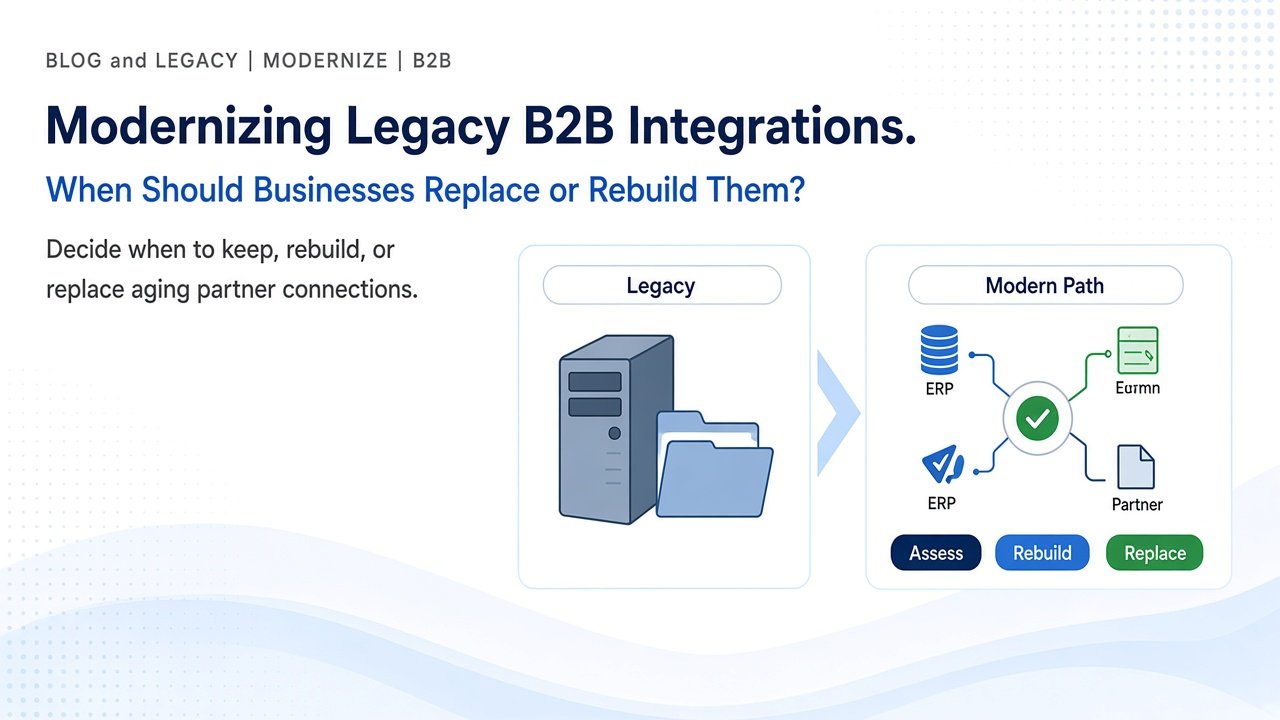
Modernizing legacy B2B integrations is the decision to keep, rebuild, or replace connections that still move orders, invoices, shipments, or claims but no longer fit how the business operates. The hard part is timing. Replace too early and you spend without need. Wait too long and a fragile link becomes an outage with a partner on the phone.
The right choice depends on risk, change velocity, and whether the current path can still be operated safely.
What Counts as a Legacy Integration
A flow can be legacy even if it is still in production.
Common signs include:
- Custom scripts or undocumented maps
- Point-to-point links outside the shared platform
- Manual file handling for exceptions
- Certificates and endpoints tracked informally
- No clean non-production path for partner testing
- Knowledge concentrated in one or two people
Age alone is not the issue. Operability is.
Keep, Rebuild, or Replace
Keep
Keep the current design when it is stable, monitored, understood, and rarely changed. A mature AS2 flow with clear ownership can stay if it meets security and audit needs.
Rebuild
Rebuild when the business purpose is still right, but the implementation is the problem. Examples: move a copied map into a shared pattern, add validation, or bring a side script into the platform without changing the partner agreement.
Replace
Replace when the technology or operating model cannot meet current requirements: unsupported protocols, no observability, unsafe credentials, or a partner program that needs scale the old design cannot provide.
Signals It Is Time to Act
Modernization should move up the backlog when several of these are true:
- Partner onboarding takes as long as it did years ago
- Small partner changes cause production incidents
- Security or certificate work requires heroics
- Finance or operations cannot see document status
- The team refuses to touch the flow without a weekend window
- A platform or vendor that hosts the connection is approaching end of life
One annoyance is not a strategy. A pattern of them is.
How to Decide Without Disrupting Partners
A practical decision path:
- Rank flows by business criticality and incident history
- Separate partner-facing behavior from internal implementation
- Prefer rebuild when the partner can keep the same document and channel
- Replace when the channel, security model, or platform must change
- Run dual paths during cutover when volume or risk is high
- Retire the old endpoint only after the new path has proven itself
Partners care about continuity. Internal teams should absorb as much of the change as possible.
What “Modern” Should Mean
Modernization is not a buzzword refresh. For B2B integrations it should deliver:
- Clear ownership and access control
- Encryption and certificate hygiene
- Validation before posting
- End-to-end visibility
- Repeatable onboarding patterns
- Safe replay and exception handling
If a replacement project does not improve those, it is only a migration.
A Simple Decision Test
Ask four questions for each legacy connection:
- Can we change it safely in the next quarter?
- Can we prove what happened to a document last Tuesday?
- Can someone other than the original builder operate it?
- Does it meet today’s security and audit bar?
Two or more “no” answers usually means rebuild or replace, not another temporary patch.
Final Takeaway
Businesses should modernize legacy B2B integrations when old connections can no longer be changed, secured, or operated with confidence. Keep what is stable, rebuild what has the right shape but the wrong implementation, and replace what blocks security, visibility, or scale.
The best timing is before the partner outage forces the decision.
Our Team Members