Message Queues in Enterprise Integration: Why Reliable Data Delivery Matters
- DataSync
- 24 Oct, 2026
- 03 Mins read
- Edi
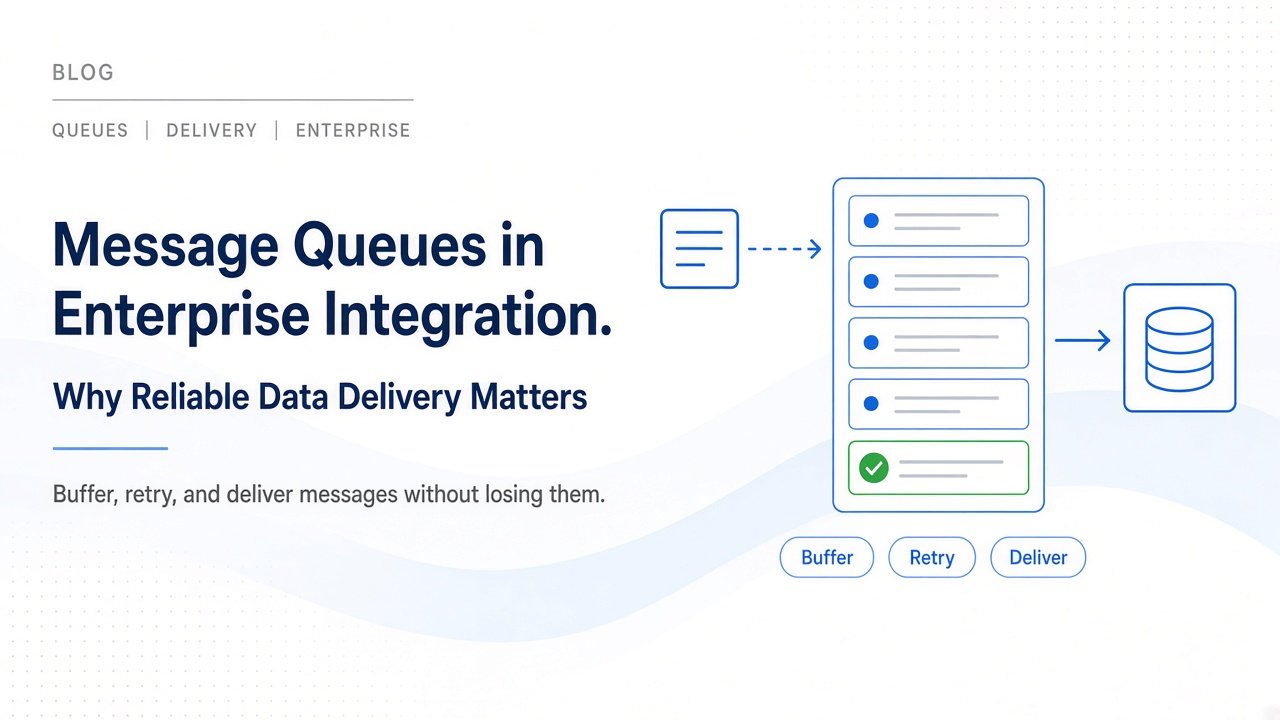
A message queue holds business messages until the next system is ready to take them. In enterprise integration, that buffer is what keeps orders, invoices, status updates, and partner documents from disappearing when a downstream application is slow, busy, or briefly down.
Reliable delivery matters because a lost message is not a technical detail. It is a missed order, an unposted payment, or a partner who never received the file.
What a Message Queue Does
The sending system places a message on a queue. The receiving system pulls it when it can process it. If the receiver is unavailable, the message waits instead of failing the whole exchange.
Queues typically provide:
- A buffer between systems that run at different speeds
- Retries when processing fails
- Ordering or prioritization where the business requires it
- A place to hold work during outages
- Separation so a spike in one flow does not crash another
The queue is not the business process. It is the delivery mechanism that protects the process.
Why Direct Delivery Breaks Under Load
Calling the next system immediately feels simple. It also couples both sides to the same moment.
If the receiver times out, the sender must decide whether to retry, skip, or fail the original transaction. Under load, those decisions pile up. Bursts of EDI documents or API callbacks can overwhelm an ERP that was sized for a steady pace.
A queue absorbs the burst and lets the receiver work through it at a sustainable rate.
Why Reliable Delivery Is an Operations Issue
Integration teams feel queue design in day-to-day exceptions.
Reliable delivery means:
- A message is not acknowledged until it is safely stored
- A failed process can be retried without creating a second business document
- Poison messages that always fail are set aside instead of blocking the line
- Operators can see what is waiting, what failed, and what was delivered
- Replay is possible after a mapping fix or a downstream outage
Without those properties, “we sent it” and “they processed it” drift apart.
Where Queues Fit in B2B and EDI Flows
Queues are especially useful between the integration layer and internal systems.
Common uses include:
- Holding validated EDI documents until the ERP accepts them
- Decoupling partner receipt from internal posting
- Buffering event notifications and webhooks
- Isolating a slow partner endpoint from the rest of the platform
- Preserving work during planned maintenance
The partner may still receive a file over AS2 or SFTP. The queue protects the steps on your side of that exchange.
Design Choices That Prevent Lost or Duplicate Work
A queue only helps if the consumers are careful.
Teams should define:
- How many times a message may be retried
- How duplicates are detected if a message is delivered twice
- When a message moves to a dead-letter or exception queue
- Which identifiers tie the message back to the original document
- Who is alerted when the queue depth or failure rate grows
Those rules turn a buffer into an operational control.
Final Takeaway
Message queues matter in enterprise integration because reliable data delivery cannot depend on every system being available at the same instant. They buffer load, survive short outages, and give operations a way to retry without losing the business transaction.
Used with duplicate protection and clear exception handling, queues keep partner and internal flows moving even when one step is not ready.
Our Team Members