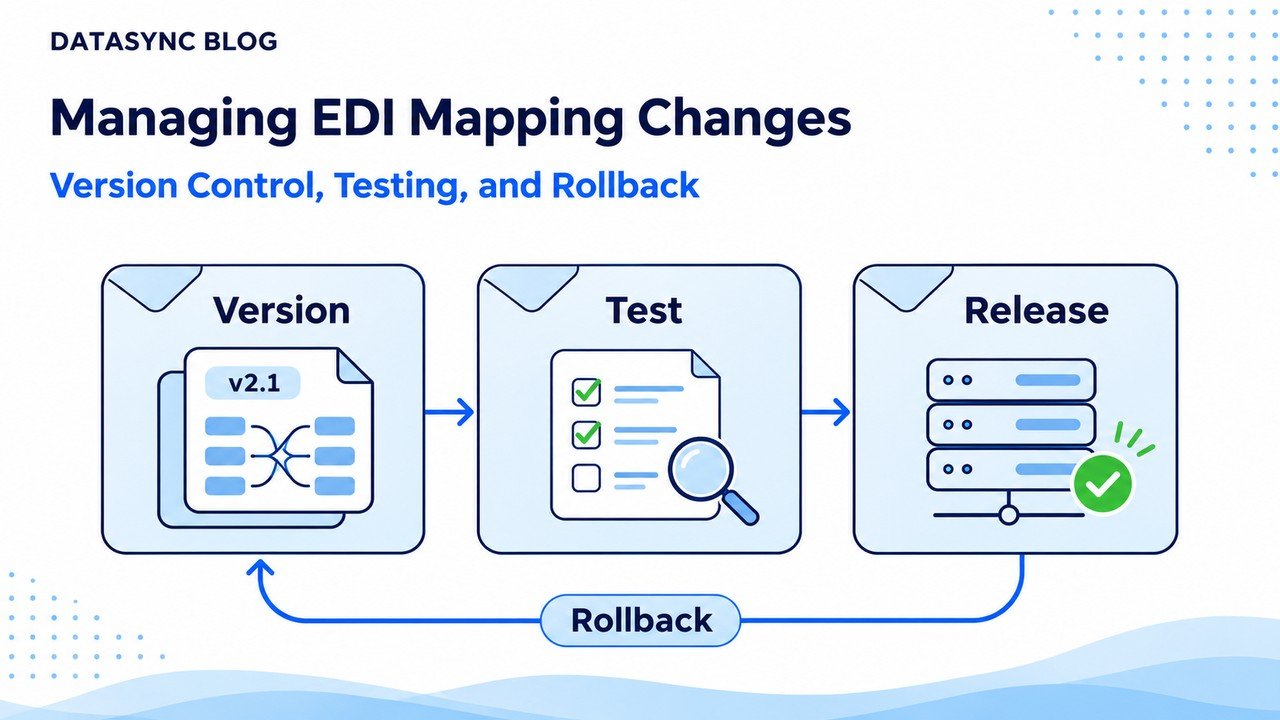
Managing EDI Mapping Changes: Version Control, Testing, and Rollback Strategies
- DataSync
- 30 Nov, 2026
- 03 Mins read
- Edi
EDI mapping changes alter how business data is interpreted or produced. A small update to a date rule, product reference, or quantity conversion can affect transactions that looked unrelated during development.
Treat a map as a released business rule with a traceable version, test evidence, and a defined recovery path.
What Counts as a Mapping Change
Changes include expressions, lookup tables, default values, schemas, and partner-specific rules. Track the configuration that influences output as well as the mapping definition itself. Platforms may expose definitions through APIs; Stedi’s mapping management guide is one example.
A change record should identify:
- The requirement and business owner
- Affected partners, documents, and directions
- Source and target schema or guide versions
- Mapping and reference-data dependencies
- Expected output differences
- Release, monitoring, and rollback responsibilities
A saved map name is not enough to reconstruct historical behavior if its lookup data or platform configuration has changed independently.
Three Controls Behind a Safe Release
Traceable Versions
Keep a reviewable record of the definition and related dependencies. Use source control or supported versioned exports to preserve what changed and why. Record the exact artifact released to each environment rather than relying on an editor’s current contents.
Meaningful Regression Tests
Use representative inputs with expected business outcomes. Cover the changed rule, important unchanged behavior, and relevant rejection cases. Compare references, quantities, dates, and totals instead of accepting any output that happens to pass structural validation.
Controlled Release and Rollback
Promote the reviewed artifact through the intended environments. Define who can release it, which version applies to queued work, and how to return to a known configuration. A rollback procedure must account for compatibility with current guides and reference data.
Signals Mapping Changes Need More Control
Review the lifecycle when:
- Operators cannot identify which map processed a document
- Production is edited directly without a retained previous definition
- A shared rule changes output for an unrelated partner
- Test samples exercise only the simplest document
- Queue reprocessing silently uses a different mapping version
- Restoring an old map is assumed to reverse completed postings
For example, changing case-to-unit conversion may produce valid EDI with incorrect quantities. Syntax checks alone will not demonstrate that the business effect is correct.
How to Release a Mapping Update
Use a documented change path:
- Define the requirement, affected scope, and expected differences
- Preserve the current release and identify its dependencies
- Implement and review the new version
- Run targeted regression and partner tests where required
- Release with explicit routing and in-flight processing rules
- Monitor business outcomes and reconcile any affected documents
Attach evidence to the release record: sample inputs, expected outputs, review decisions, and deployed versions. This helps a reviewer assess the change without reconstructing it from an incident later.
What a Useful Rollback Plan Should Mean
The plan should provide:
- A retrievable prior artifact and compatible dependencies
- A decision owner and rollback trigger
- Clear handling of queued and partly processed work
- Identification of documents processed by the faulty version
- Partner coordination for corrections or resubmissions
- Reconciliation of application and accounting effects
Rolling back a map changes future processing behavior. It does not retract a file already received by a partner or automatically reverse a posted invoice. Treat those outcomes as a separate correction workflow.
A Simple Mapping Release Test
Ask four questions before deployment:
- Can we identify the exact version and dependencies being released?
- Do tests show the intended change and relevant unchanged behavior?
- Can we explain which version will process in-flight documents?
- Can we recover configuration and identify affected business records?
If an answer is missing, resolve that release dependency before increasing the number of live documents exposed to the change.
Final Takeaway
Reliable mapping changes require more than saving a new transformation. Version history, meaningful tests, and controlled deployment make the behavior reviewable.
Pair configuration rollback with document-level reconciliation so recovery addresses both the map and its business consequences.
Our Team Members