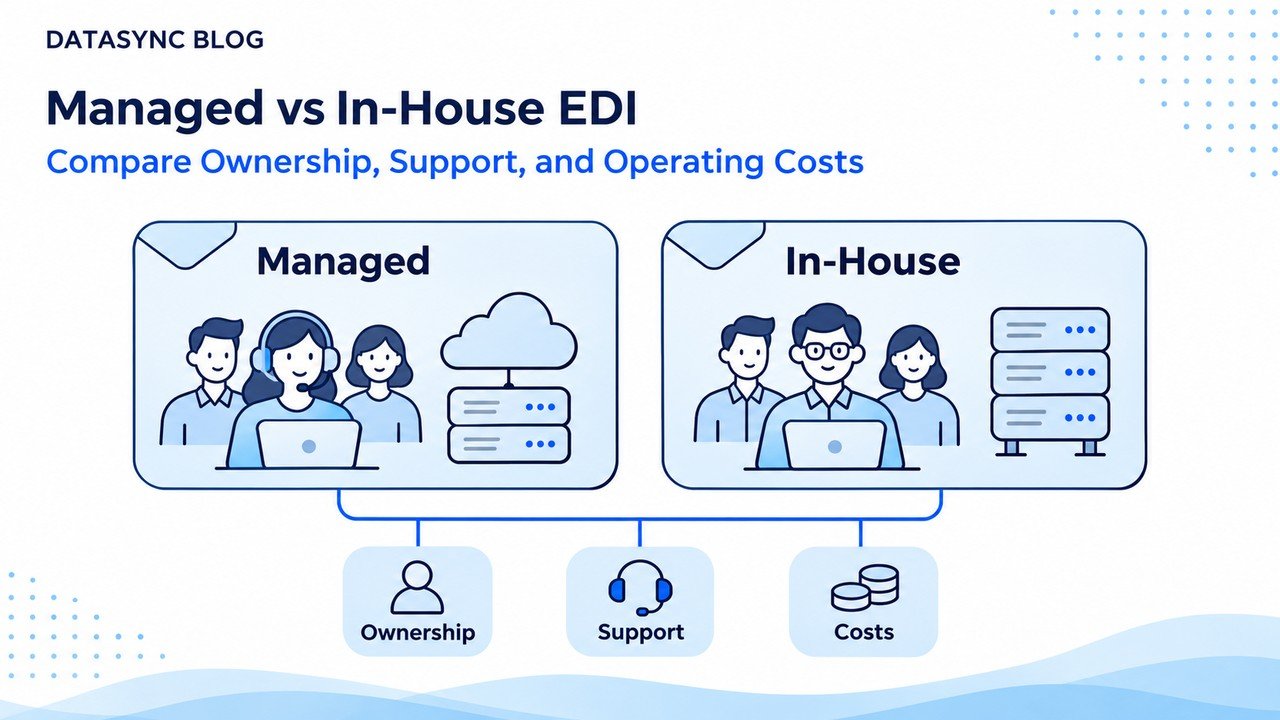
Managed EDI Services vs In-House EDI: Comparing Ownership, Support, and Operating Costs
- DataSync
- 25 Nov, 2026
- 03 Mins read
- Edi
Managed EDI services vs in-house EDI is a decision about who runs the integration work and how the business maintains control over its outcomes. Software location alone does not answer who onboards partners, changes maps, investigates incidents, or restores service.
Compare the operating responsibilities and support commitments before comparing prices.
What Counts as an EDI Operating Model
An in-house team can operate cloud software, and a managed service can still require substantial internal work. Managed scope varies by agreement; IBM’s EDI implementation overview describes both self-managed and third-party implementation approaches.
Make the comparison cover the same responsibilities:
- Partner onboarding and implementation coordination
- Mapping, validation, and change management
- Monitoring, support coverage, and incident escalation
- Certificates, connectivity, and access administration
- Recovery, replay, and business reconciliation
- Reporting, documentation, and eventual service transition
Keep business approval and master-data ownership explicit. Outsourcing technical operations does not automatically transfer decisions about disputed orders or accounting corrections.
Three Models to Compare
In-House EDI
Internal staff own the agreed technical operations and coordinate with software and network providers. This can support direct prioritization and close application knowledge. Include staffing depth, out-of-hours cover, platform maintenance, and training in the operating plan.
Managed EDI Services
A provider performs the functions included in the service agreement. Examine response commitments, change queues, partner communication, and exclusions. A broad service description should translate into named responsibilities and evidence of what happens during an actual incident.
Shared Ownership
A hybrid arrangement may leave ERP integration and business rules internally while a provider handles transport or partner operations. Define handoffs carefully so both teams know who investigates first and who owns the next action.
Signals Ownership Is Unclear
Review the model when:
- Provider and internal support repeatedly redirect the same incident
- Onboarding waits for an unnamed approver
- Certificate renewals have no clear owner
- Map changes incur unexpected delays or charges
- Monitoring ends before application posting
- Recovery procedures depend on one person
These problems can occur under any operating model. The useful comparison is how each proposed arrangement prevents or resolves them.
How to Compare Support and Costs Fairly
Use one consistent evaluation process:
- Inventory current partners, volumes, documents, and application connections
- Define required support hours and business deadlines
- Assign responsibilities for routine work, changes, and incidents
- Estimate implementation, recurring, and change-related costs
- Walk through an onboarding request and a production outage
- Review data access, documentation, and transition arrangements
For an internal option, include staff time, cover, tooling, hosting, maintenance, and training. For a managed option, check subscriptions, volume tiers, onboarding, map changes, support levels, and internal coordination effort. Use actual proposals and workload data rather than an assumed universal saving.
What a Useful Service Agreement Should Mean
The agreed operating model should provide:
- Named responsibility for every critical activity
- Measurable support and escalation commitments
- A defined process for requesting and approving changes
- Visibility into document and application outcomes
- Accessible configuration and operating documentation
- Clear data-export and transition provisions
Test responsibilities against an example: a partner changes its invoice guide shortly before a deadline. Both sides should know who assesses, builds, approves, tests, and releases the update.
A Simple Ownership Test
Ask four questions of each proposed arrangement:
- Who detects and investigates a failed exchange?
- Who can approve and release a mapping change?
- What happens when the primary specialist is unavailable?
- Can the business explain the full cost and transition process?
An unanswered question represents an operating dependency, even when the quoted platform price is clear.
Final Takeaway
Managed, in-house, and shared EDI models can each support a reliable operation when responsibilities and capacity fit the business.
Compare ownership, support evidence, and the complete workload cost so the selected arrangement remains workable after implementation.
Our Team Members