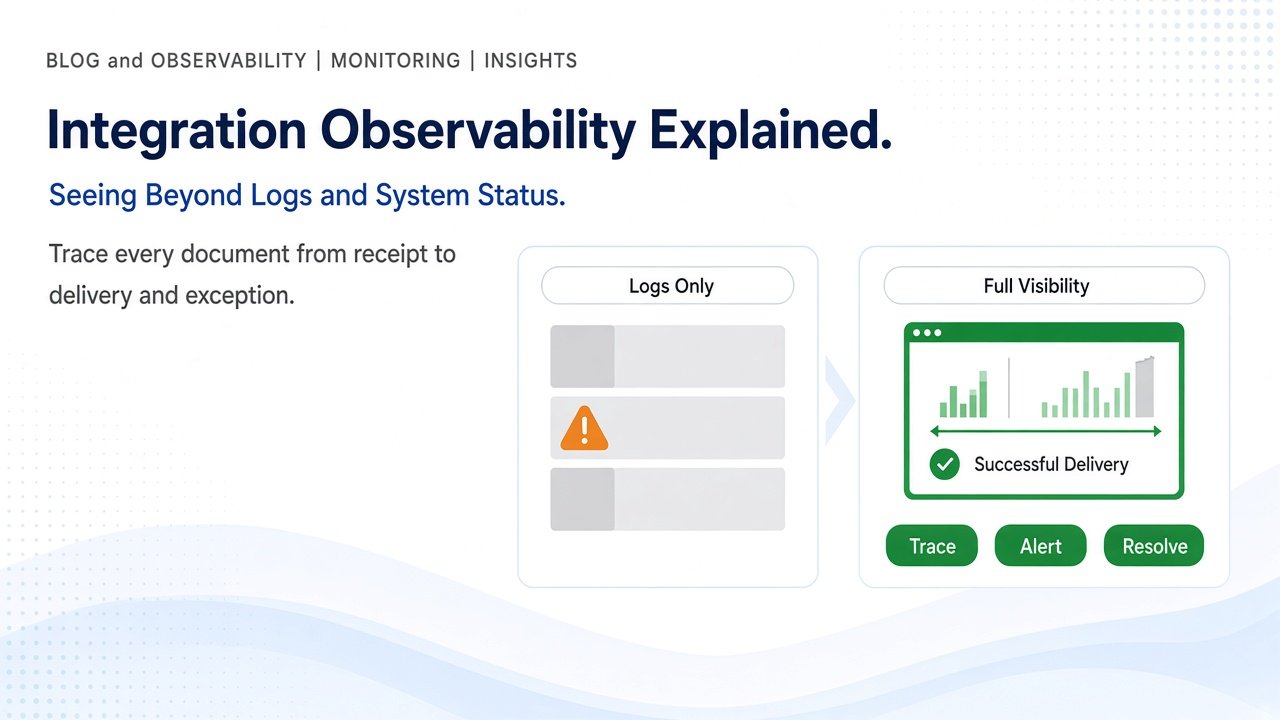
Integration Observability Explained: Seeing Beyond Logs and System Status
- DataSync
- 04 Nov, 2026
- 03 Mins read
- Edi
Integration observability is the ability to see what happened to a business document after it entered the platform, not only whether a server was up. Logs and system status still matter. They do not answer the question operations teams ask first: did this order, invoice, or claim reach the right place, and if not, where did it stop?
Seeing beyond logs is what turns firefighting into controlled exception handling.
Why Logs Alone Fall Short
A log can say a process started, a file was read, or an API returned an error. It rarely connects those lines into a business story.
Teams with log-only visibility usually struggle to answer:
- Which partner and document type failed?
- Was the failure at receipt, validation, mapping, or delivery?
- Did the partner already get an acknowledgment?
- Is this a new defect or a repeat of yesterday’s map issue?
- Who owns the next action?
Searching raw logs for a control number is not observability. It is archaeology under time pressure.
What Observability Adds
Observability links technical signals to the transaction.
A useful view includes:
- End-to-end status from receipt to delivery or hold
- Partner, document type, and environment on every record
- Validation and mapping outcomes with readable reasons
- Latency between steps
- Retry history and final disposition
- Alerts when volume, failure rate, or delay crosses a threshold
The goal is not more screens. The goal is a single place where an operator can follow one document without guessing.
System Status Is Necessary but Incomplete
“CPU normal” and “service healthy” can be true while every invoice for one partner is stuck on a bad identifier.
Status checks prove the platform is running. Observability proves the business flow is working. Both are required. Only one of them tells finance why remittance posting stopped.
The Signals That Matter Most
Strong integration observability focuses on outcomes:
- Documents received versus documents successfully posted
- Open exceptions by partner and error class
- Aging items that have not moved for too long
- Acknowledgment mismatches
- Sudden drops or spikes in partner volume
- Reprocess success rate after a fix
Those metrics show risk before a partner calls.
How to Move Beyond Log Search
A practical path looks like this:
- Give every document a durable correlation ID
- Record each major step with the same ID
- Store failure reasons in business language, not only stack traces
- Build queues for held and failed work
- Alert on patterns, not only single crashes
- Keep enough history to compare today’s failures with last week’s
Once that exists, logs become supporting evidence instead of the only tool.
What Good Looks Like in an Incident
With observability, an operator can open one transaction and see:
- Received from Partner A at 09:12
- Validation failed on ship-to code
- Held for business review
- No ERP post attempted
- Similar failures rising since the morning map change
That is enough to assign ownership and stop the blast radius. Without it, three teams argue from three different log files.
Final Takeaway
Integration observability means seeing beyond logs and system status to the fate of each business document. Uptime tells you the platform is alive. Traceability, exception views, and partner-level outcomes tell you whether the business process is alive.
Teams that invest in that visibility find failures earlier, explain them faster, and spend less time reconstructing what already happened.
Our Team Members