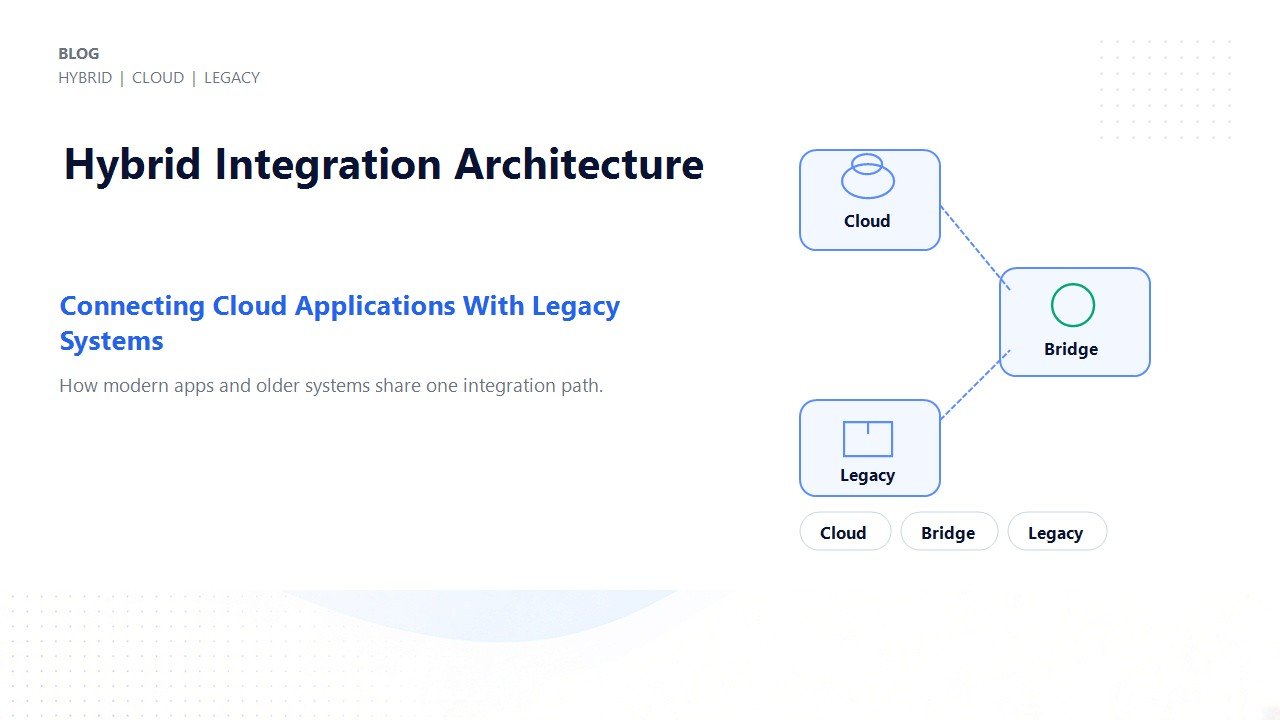
Hybrid Integration Architecture: Connecting Cloud Applications With Legacy Systems
- DataSync
- 27 Oct, 2026
- 03 Mins read
- Edi
Hybrid integration architecture connects cloud applications and legacy systems without forcing either side to change first. Orders, invoices, inventory, and partner documents can move through one integration layer while the ERP, warehouse platform, or older interface stays in place.
That matters because most enterprises are not cloud-only. The business still depends on systems that were never designed for modern APIs.
What Hybrid Integration Actually Connects
A hybrid landscape usually includes both of these:
- Cloud apps such as CRM, procurement, or a partner portal
- Legacy systems such as an on-prem ERP, mainframe extract, or file-based warehouse platform
- External partners that still exchange EDI, SFTP, or AS2 files
The integration layer sits between them. Cloud apps do not need a custom adapter for every legacy screen, and the legacy system does not need to be rewritten to call every new API.
Why a Direct Cloud-to-Legacy Link Breaks Down
A one-off connection feels fast. It also ties a release in the cloud app to a change window on the older system.
Common failure points include:
- The legacy system only accepts files or a fixed interface
- The cloud app expects real-time APIs and immediate responses
- Credentials, certificates, and network access live in different places
- Failures are visible in one system and invisible in the other
- The same mapping is copied the next time a new app is added
Hybrid architecture exists so those differences are handled once.
How a Shared Integration Path Works
A practical hybrid flow looks like this:
- A cloud application or partner sends a business event or document.
- The integration layer validates, maps, and routes it.
- The legacy system receives the format it already understands.
- Status, errors, and acknowledgments return on the same path.
- Operations can see the exchange without logging into both platforms.
The older system stays stable. New cloud applications join the same path instead of building a private one.
What Teams Should Design Up Front
Hybrid integration holds up when a few decisions are explicit:
- Which system owns the business record
- Which protocol each side can actually support
- How retries work when the legacy system is in a maintenance window
- How cloud credentials and on-prem access are separated
- How a failed document is replayed after a mapping fix
Without those rules, the “bridge” becomes another unmanaged script.
Where Hybrid Architecture Fits Best
It is the right model when:
- A legacy ERP or WMS cannot be replaced on the project timeline
- New cloud tools must exchange data with that system this quarter
- Partners still require EDI or file delivery
- Operations need one view of receipt, failure, and delivery
It is the wrong shortcut when every new flow bypasses the shared layer and lands directly in the legacy database.
Final Takeaway
Hybrid integration architecture lets cloud applications and legacy systems exchange business data through one controlled path. Enterprises use it to add modern tools without rewriting the systems that still run orders, inventory, and finance.
The approach scales when mapping, security, and exception handling stay in the integration layer instead of being rebuilt for every new application.
Our Team Members