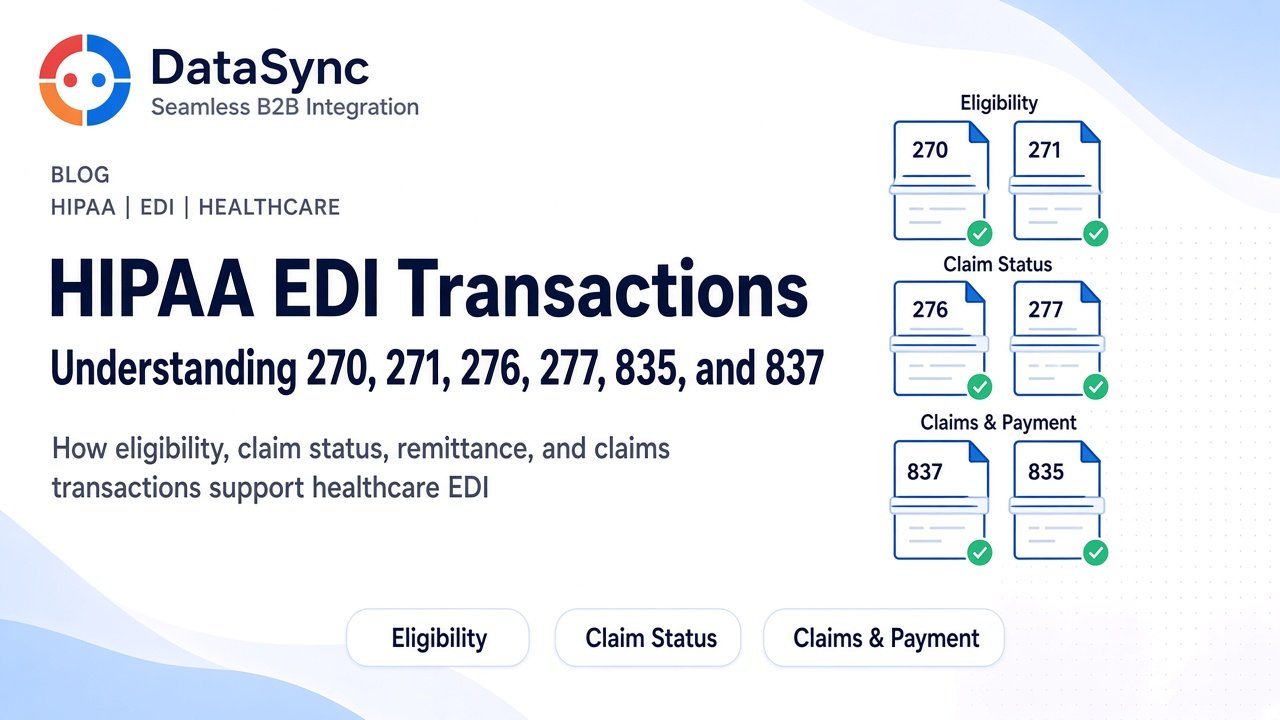
HIPAA EDI Transactions: Understanding 270, 271, 276, 277, 835, and 837
- DataSync
- 12 Oct, 2026
- 03 Mins read
- Edi
HIPAA EDI transactions are the standardized X12 documents used across healthcare to exchange eligibility, claim status, claims, and remittance data electronically. For providers, payers, and clearinghouses, these transaction sets are the foundation of day-to-day administrative workflows.
If your team works with healthcare EDI, understanding 270, 271, 276, 277, 835, and 837 helps you see how each step of the revenue cycle is connected.
Why HIPAA EDI Transactions Matter
Healthcare operations depend on fast, consistent answers to operational questions:
- Is the patient eligible for coverage?
- What is the status of a submitted claim?
- Has the claim been accepted and paid?
- How should remittance be posted?
HIPAA-adopted EDI transactions give partners a shared format for asking and answering those questions at scale. That reduces portal hopping, phone calls, and manual rework.
Eligibility: EDI 270 and 271
EDI 270: Eligibility, Coverage, or Benefit Inquiry
The 270 is the inquiry transaction used to ask a payer about a member’s eligibility, coverage, or benefits.
Providers typically use it before services are rendered to confirm:
- Active coverage
- Plan details
- Benefit limits
- Relevant service or date-of-service checks
EDI 271: Eligibility, Coverage, or Benefit Information
The 271 is the response to a 270. It returns eligibility and benefit information so front-office and billing teams can proceed with clearer expectations.
Together, 270/271 reduce denied claims caused by inactive coverage or misunderstood benefits before care and billing move forward.
Claim Status: EDI 276 and 277
EDI 276: Health Care Claim Status Request
The 276 is used to ask a payer for the status of a previously submitted claim.
Operations teams use it when they need visibility into whether a claim is:
- Received
- Pending
- Paid
- Rejected
- Otherwise delayed in payer processing
EDI 277: Health Care Claim Status Response
The 277 responds to a 276 with claim status details. In many programs, related claim status responses also support proactive payer feedback during the claims lifecycle.
276/277 matter because claim status visibility helps revenue cycle teams follow up with the right action instead of waiting blindly for remittance.
Claims and Payment: EDI 837 and 835
EDI 837: Health Care Claim
The 837 is the claim submission transaction. It carries encounter or claim data from a provider to a payer or clearinghouse.
Common variants include:
- 837P for professional claims
- 837I for institutional claims
- 837D for dental claims
This is the core transaction that starts the electronic claims process.
EDI 835: Health Care Claim Payment/Advice
The 835 returns remittance and payment advice from the payer to the provider. It explains what was paid, adjusted, denied, or left outstanding.
Without reliable 835 processing, finance teams struggle to post payments accurately and reconcile claims to cash.
How These Transactions Work Together
In a typical healthcare EDI flow:
- A provider checks eligibility with a 270 and receives a 271.
- The provider submits a claim with an 837.
- If status is unclear, the provider requests updates with a 276 and receives a 277.
- Payment and remittance details arrive in an 835.
Each transaction answers a different operational question. Together, they create an end-to-end electronic path from coverage check to claim payment.
What Operations Teams Should Track
Strong HIPAA EDI programs do more than send files. They monitor:
- Eligibility response quality and turnaround
- Claim acceptance and rejection patterns
- Claim status lag between submission and remittance
- Remittance posting accuracy from 835 data
- Partner-specific companion guide requirements
When these signals are visible, teams can reduce denials, speed up follow-up, and close the gap between clinical-admin activity and cash collection.
Final Takeaway
HIPAA EDI transactions like 270, 271, 276, 277, 835, and 837 are the operational backbone of electronic healthcare administration. Eligibility inquiries, claim status checks, claim submission, and remittance advice each play a distinct role in keeping revenue cycle work moving.
Teams that understand how these transactions connect can diagnose issues faster, improve payer communication, and run more reliable healthcare EDI programs.
Our Team Members