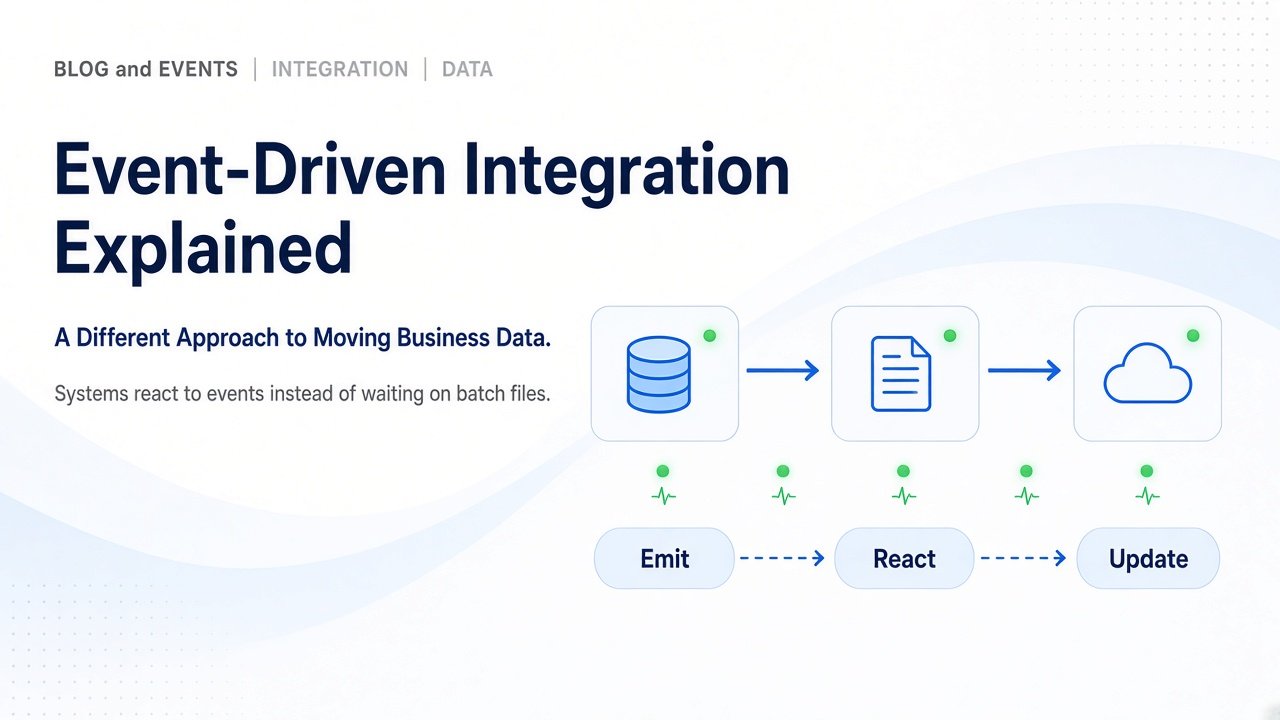
Event-Driven Integration Explained: A Different Approach to Moving Business Data
- DataSync
- 22 Oct, 2026
- 03 Mins read
- Edi
Event-driven integration moves business data when something happens, not when a schedule says it is time to look. A shipment is created, an invoice is approved, or a claim status changes, and that event triggers the next system to act.
It is a different approach from traditional batch files, and it fits enterprise workflows that cannot wait for the next polling cycle.
What an Event Is in Integration
An event is a fact about the business that other systems may need.
Examples include:
- A purchase order was accepted
- Inventory dropped below a threshold
- A claim was paid or denied
- A partner certificate is nearing expiration
- A document failed validation
The event carries enough context for another process to react. It does not require the receiving system to ask, on a timer, whether anything new exists.
How Event-Driven Integration Differs From Batch Exchange
Batch integration collects records and sends them on a schedule. It is reliable and still the right model for many EDI document flows.
Event-driven integration publishes a change as it occurs. Downstream systems subscribe to the events they care about and update their own state.
The difference is timing and coupling:
- Batch is periodic and file-oriented
- Events are immediate and change-oriented
- Batch often moves a full document set
- Events often move a single business fact plus references
Many enterprises use both. Orders may still travel as EDI, while internal status updates travel as events.
Why Teams Adopt This Approach
Event-driven flows reduce waiting. A warehouse does not need the next hourly file to learn that an order changed. Finance does not need a nightly sweep to learn that a remittance posted.
They also reduce unnecessary traffic. Systems exchange data because something changed, not because a job ran and found nothing new.
For operations, events create a clearer story: this fact happened, these systems were notified, and this step failed or completed.
Where Event-Driven Integration Fits
It works well when:
- Several internal systems must react to the same business change
- Latency matters more than moving a large file
- Teams want to decouple producers from every downstream consumer
- Status, exceptions, or acknowledgments should fan out quickly
It is a weaker fit when partners require a complete EDI document, a specific protocol, or a scheduled batch window. In those cases the event can still start the process, while middleware assembles and delivers the required document.
What Can Go Wrong
Events fail in familiar ways if the design is thin.
- Consumers miss events and have no replay path
- The same event is processed twice and creates duplicates
- Payloads lack the identifiers needed to update the right record
- There is no trace from the event back to the original document
- Teams treat “published” as the same thing as “processed”
Reliable event-driven integration needs idempotency, retention, and the same operational visibility expected from EDI.
Final Takeaway
Event-driven integration is a different way to move business data: systems react to facts as they happen instead of waiting for the next file. It complements EDI and batch exchange, especially inside the enterprise where status and exceptions need to travel quickly.
Teams that add replay, duplicate protection, and end-to-end tracking get the speed of events without losing control of the business process.
Our Team Members