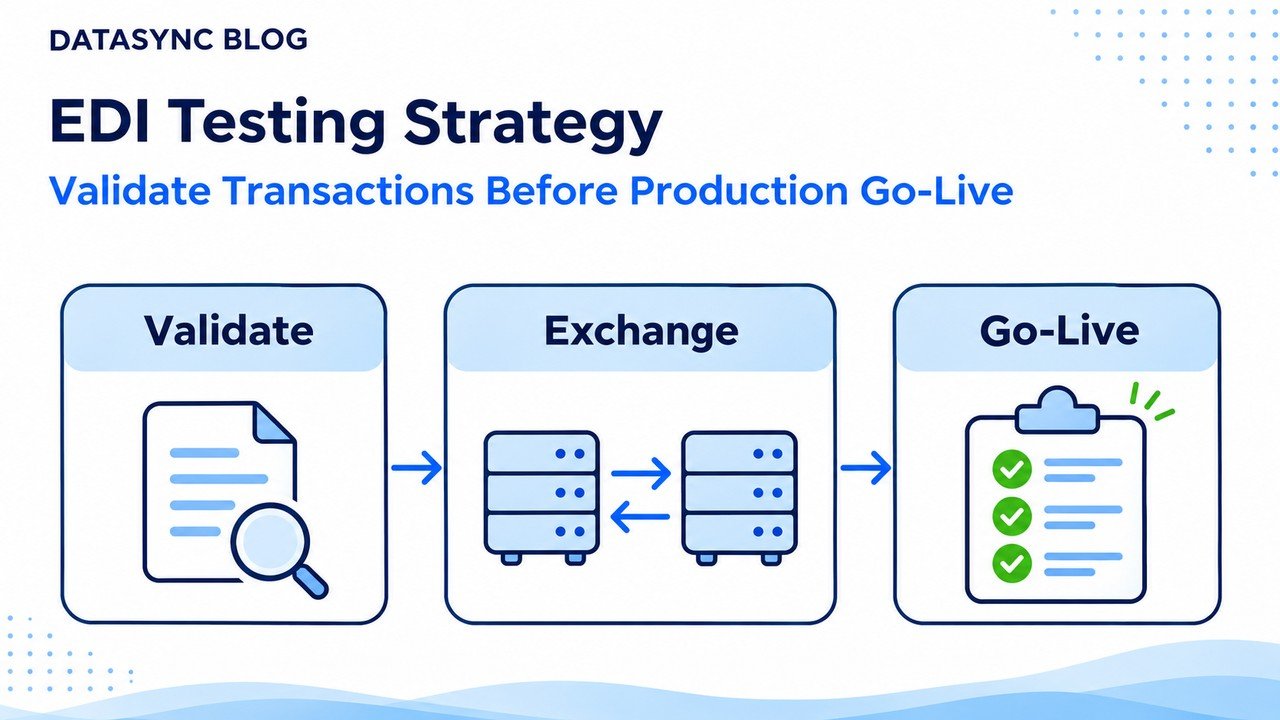
EDI Testing Strategy: How to Validate Transactions Before Production Go-Live
- DataSync
- 15 Nov, 2026
- 03 Mins read
- Edi
EDI testing strategy should establish that a transaction can travel from a source system to the right business outcome, with failures visible along the way. A file that passes a syntax check can still contain the wrong product, quantity, location, or business reference.
Before go-live, agree on what each test proves and who will confirm the result.
What Counts as EDI Readiness
Readiness includes the document, its transport, the partner agreement, and the receiving application’s behavior.
A useful test plan records:
- Transaction types and implementation guide versions
- Representative business scenarios and sample data
- Partner IDs, endpoints, and certificate settings
- Expected acknowledgments and response times
- Expected ERP or warehouse processing results
- Owners, evidence, and exit criteria for each scenario
Use controlled test data and keep test traffic away from live posting paths. A successful sample should be repeatable by someone other than its original author.
Three Layers of EDI Testing
Syntax and Envelope Validation
Check delimiters, required elements, data types, control numbers, and trailer counts. Validate against the intended version and partner guide. Guide-based validation tools can help catch these structural issues; Stedi’s EDI Inspector documentation describes validating files against a guide.
Partner and Business Rules
Test identifiers, allowed codes, units of measure, quantities, and business references against agreed examples. For instance, an invoice can be structurally valid while referencing an unknown purchase order. Include cases that should be rejected, and specify the error the operator should see.
End-to-End Processing
Send through the intended test connection and confirm receipt, acknowledgment, transformation, and application posting. Follow the business record to completion. An AS2 MDN and a functional acknowledgment provide evidence at different stages; neither alone proves the target application posted the intended result.
Signals the Test Plan Has Gaps
Expand coverage when:
- Every sample is a simple successful document
- The partner validates a file that never reaches the ERP
- Rejected acknowledgments do not create a visible exception
- Replayed samples create duplicate business records
- High-volume behavior has not been exercised
- Operations cannot explain how to recover a failed document
Include realistic differences such as optional fields, multiple lines, partial shipments, and rounding behavior where those scenarios apply.
How to Validate Before Go-Live
Use a sequence that produces reviewable evidence:
- Agree on the guide, scenarios, expected results, and responsible reviewers
- Validate maps and envelopes with both accepted and rejected samples
- Exercise the actual test channel and acknowledgment flow
- Confirm business records and totals in the receiving application
- Test duplicate handling, recovery, and representative peak volumes
- Resolve material defects and record partner and internal sign-off
Maintain a result for each scenario: input, configuration version, expected outcome, actual outcome, and evidence. Screenshots alone can miss the relationship between a payload and the record it created.
What Useful Regression Coverage Should Mean
Keep a small, meaningful suite that covers:
- Common partner document variations
- Invalid codes and missing required references
- Duplicate and out-of-order delivery scenarios
- Certificate or connection configuration changes
- Failed posting followed by controlled recovery
- Acknowledgment delays and explicit rejections
Repeat the affected scenarios after changes to maps, guides, or platform settings. Expand testing when the change introduces a new failure mode, rather than rerunning samples without a reason.
A Simple Go-Live Test
Ask four questions at the readiness review:
- Has the partner confirmed the intended scenarios?
- Do valid documents create the correct business records?
- Are rejected and uncertain outcomes visible to operations?
- Has the team demonstrated recovery without duplicate posting?
An unresolved answer should have a named owner and a clear effect on the release decision.
Final Takeaway
EDI testing should prove the complete exchange, including expected failures and recovery. Structural validation is a starting point, followed by partner rules and actual application outcomes.
Go-live becomes easier to assess when each claim of readiness has evidence behind it.
Our Team Members