EDI Sandbox Environments: How Self-Service Testing Accelerates Partner Integration
- DataSync
- 28 Nov, 2026
- 03 Mins read
- Edi
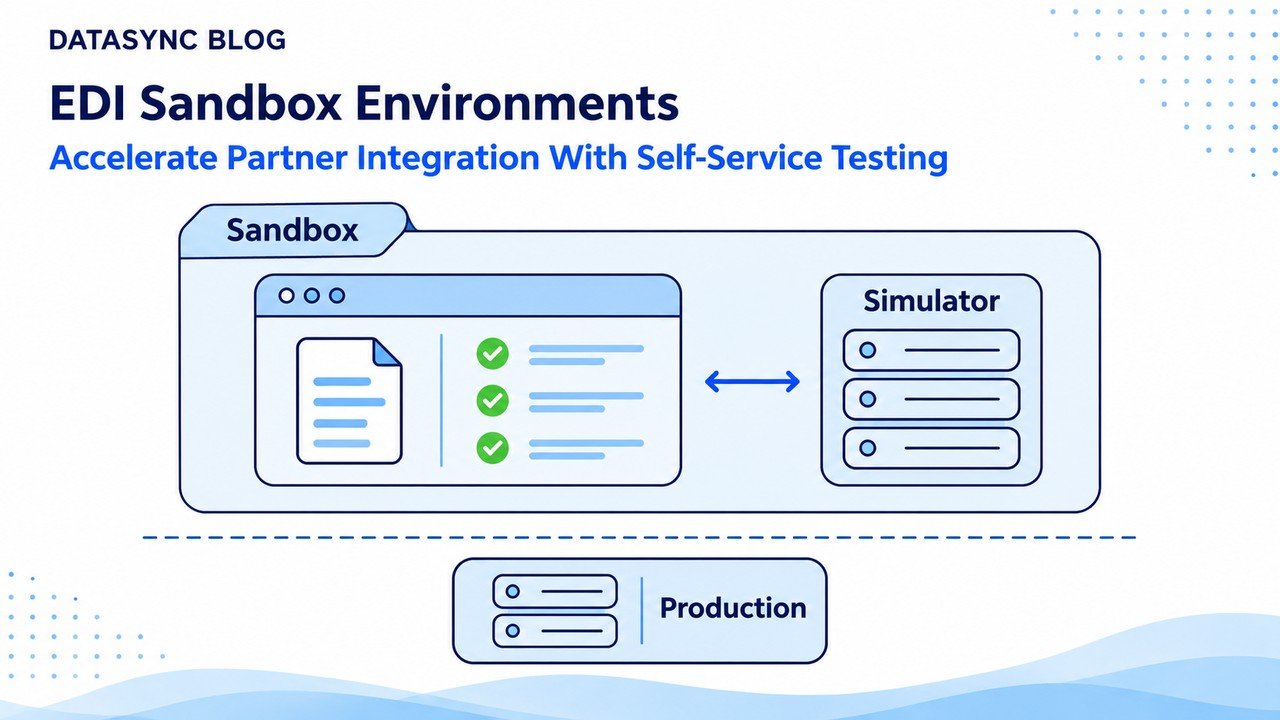
EDI sandbox environments let partners test supported integration behavior before their connection handles live business traffic. Self-service access can shorten feedback loops when partners can submit a sample, inspect the result, and correct the next attempt without waiting for a manual review each time.
The environment needs clear boundaries and an honest description of what its tests can prove.
What Counts as an EDI Sandbox
A sandbox may provide test endpoints, validation tools, sample data, partner simulators, or a combination of those capabilities. A separate test mode is one implementation pattern; Stedi’s test-mode documentation shows both supported workflows and explicit feature limitations.
A useful sandbox should publish:
- Test credentials and connection instructions
- Supported transaction types and guide versions
- Example payloads and expected outcomes
- Validation and acknowledgment behavior
- Simulator assumptions and unsupported scenarios
- The process for requesting production readiness review
Label simulated responses clearly. A mock acceptance demonstrates the configured simulation, not an actual trading partner’s approval.
Three Capabilities That Enable Self-Service
Safe Test Access
Separate test identities, endpoints, routing, and data from production operations. A test flag in an EDI envelope is useful context, but the environment also needs controls that prevent accidental live delivery or posting.
Useful Scenarios and Samples
Provide realistic successful and unsuccessful examples. Partners should be able to test missing references, invalid values, duplicates, and corrections where supported. Each scenario needs an expected result and a description of the behavior being exercised.
Actionable Feedback
Return errors that identify the affected field, rule, or processing stage. Expose test status and available acknowledgment evidence. A generic failure message simply moves the support queue into a different interface.
Signals the Sandbox Is Not Helping Partners
Review the experience when:
- Credentials require repeated manual intervention
- Samples differ from the published guide version
- Every simulator response succeeds regardless of the input
- Partners cannot retrieve previous results
- Tests can trigger production webhooks or downstream posting
- Sandbox success is mistaken for completed partner certification
A self-service environment still needs support for problems the available tests cannot explain.
How to Build a Useful Partner Test Journey
Make the path repeatable:
- Issue authorized test access and document the environment boundary
- Let the partner retrieve a guide and runnable sample
- Accept a test submission and return a searchable reference
- Show validation results and the simulated or actual test response
- Allow corrected submissions and comparison with expected outcomes
- Collect evidence for partner testing and production readiness review
For example, a partner testing an invoice with an unknown order reference should see a defined rejection scenario. The same submission should not receive a success response merely because its X12 syntax is valid.
What Production Promotion Should Mean
The handoff should include:
- An approved configuration and guide version
- Evidence for required business scenarios
- Separate production credentials and destinations
- Confirmed partner communication and acknowledgment expectations
- Internal support ownership and recovery instructions
- A small, observable initial production exchange
Document differences between environments, including simulated systems, volume limits, and partner connectivity. Those differences identify what still needs testing outside the sandbox.
A Simple Sandbox Test
Ask four questions as a newly onboarded partner:
- Can we submit the first supported sample using the documentation?
- Can we deliberately trigger and understand a validation failure?
- Can we prove our test traffic stays within the intended environment?
- Can we identify the remaining steps before production use?
A clear answer to each question indicates that self-service testing is reducing uncertainty rather than hiding it.
Final Takeaway
EDI sandboxes can accelerate onboarding when they provide usable access, meaningful scenarios, and actionable feedback. Their value depends on clear isolation and transparent simulation limits.
Connect sandbox evidence to the partner’s actual readiness process so faster testing supports a controlled go-live.
Our Team Members