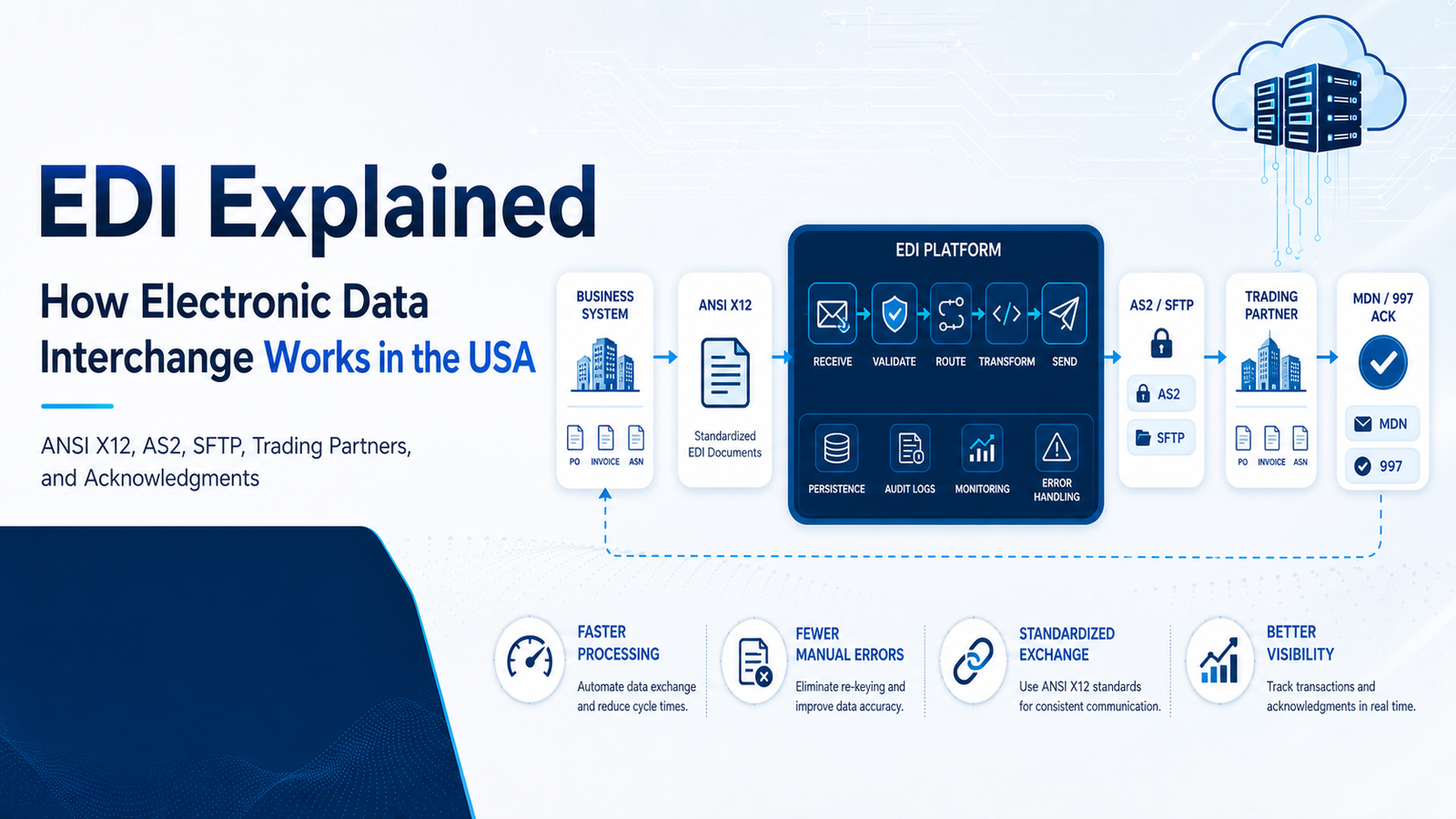
EDI Explained: How Electronic Data Interchange Works in the USA
- DataSync
- 13 Aug, 2026
- 03 Mins read
- Edi
Electronic Data Interchange, or EDI, lets businesses exchange documents like purchase orders, invoices, and shipping notices directly between systems.
In the USA, EDI is widely used in retail, logistics, manufacturing, and healthcare because it reduces manual work and speeds up partner communication.
What is EDI?
EDI is a standard way for two businesses to send structured data from one computer system to another without retyping information by hand.
For example, a retailer can send an electronic purchase order to a supplier, and the supplier can process it automatically inside its own system.
EDI Standards in the USA
The most common EDI standard in the United States is ANSI X12. It defines fixed formats for business transactions such as:
- 850 - Purchase Order
- 810 - Invoice
- 856 - Advance Ship Notice
- 855 - Purchase Order Acknowledgment
- 997 - Functional Acknowledgment
Because each document follows a known structure, different companies can exchange data consistently.
How an EDI Transaction Works
A typical EDI flow looks like this:
- A business system creates a document such as an order or invoice
- The EDI platform converts it into ANSI X12
- The file is sent through AS2 or SFTP
- The trading partner validates the document
- Acknowledgments confirm receipt or acceptance
This keeps document exchange fast, standardized, and traceable.
Trading Partners
Companies that exchange EDI documents are called trading partners. Each partner usually has its own setup, including:
- Sender and receiver IDs
- Supported transaction types
- AS2 or SFTP settings
- Certificates and encryption rules
- Mapping and acknowledgment requirements
A good EDI platform manages these partner settings centrally.
How EDI Documents are Transferred
EDI standards define the document format, while protocols define how the file is delivered.
AS2
AS2 is a common secure transport method for EDI. It supports encryption, digital signatures, and delivery confirmations called MDNs.
SFTP
SFTP is another popular option. Businesses place EDI files in secure folders, and the EDI platform picks them up for processing.
What is an AS2 MDN?
An MDN confirms that an AS2 message was received at the transport level.
What is a 997 Functional Acknowledgment?
A 997 Functional Acknowledgment confirms whether an X12 document was structurally accepted or rejected.
MDN vs 997
MDN and 997 serve different purposes:
- MDN confirms transport delivery of an AS2 message
- 997 confirms structural validation of the EDI document
That difference matters when troubleshooting failed exchanges.
What Happens After Receipt
Once a file arrives, the EDI platform typically:
- Identifies the trading partner
- Validates the document structure
- Transforms the data into an internal format
- Routes it to the correct business workflow
- Sends acknowledgments when required
Modern platforms also detect duplicates, log errors, and track every step for audit and support teams.
Why Businesses Use EDI
EDI helps businesses:
- Process transactions faster
- Reduce manual data-entry mistakes
- Automate order, invoice, and shipment workflows
- Track partner activity in one place
- Scale across many trading partners
In short, EDI helps US businesses exchange critical documents in a way that is faster, more accurate, and easier to manage at scale.
Our Team Members