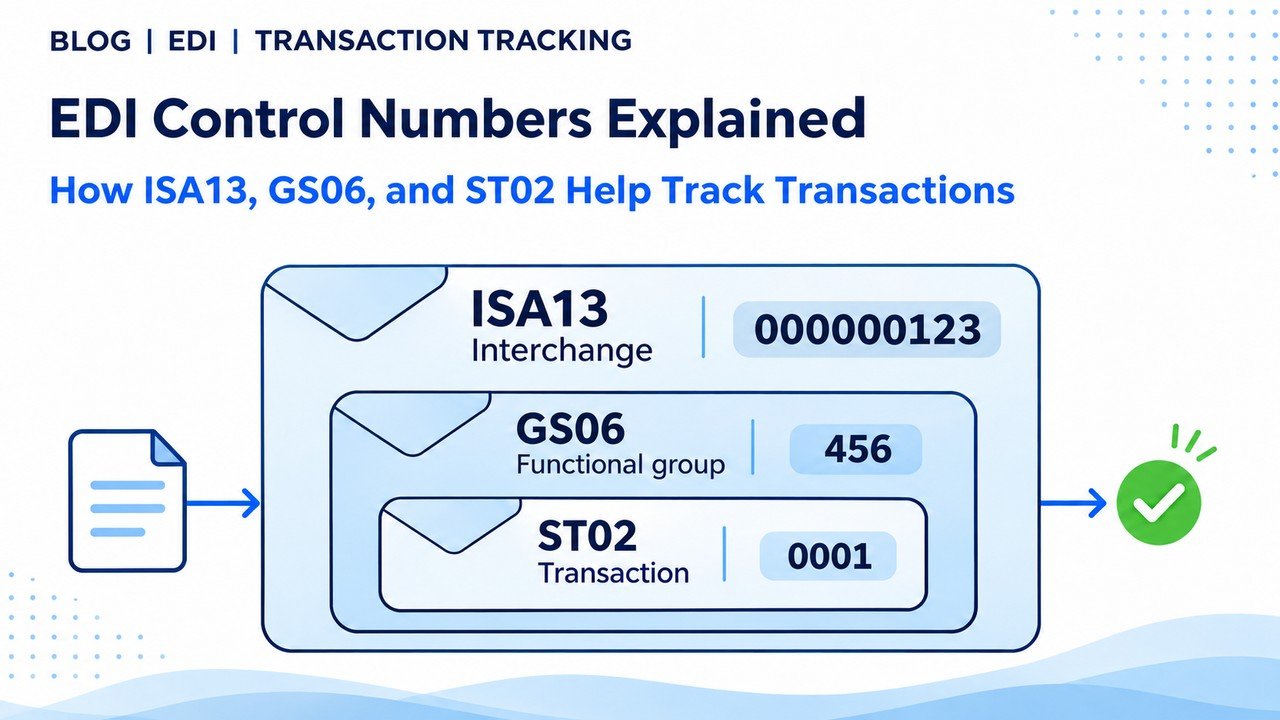
EDI Control Numbers Explained: How ISA13, GS06, and ST02 Help Track Transactions
- DataSync
- 10 Nov, 2026
- 04 Mins read
- Edi
EDI control numbers help teams identify the interchange, functional group, and transaction set involved in an X12 exchange. When a partner reports a missing invoice or a rejected order, ISA13, GS06, and ST02 provide a trail back to the message that carried it.
The key is knowing which number identifies which layer, and keeping those numbers connected throughout processing.
What Counts as an EDI Control Number
A control number is an identifier assigned by the sender to an EDI envelope. It helps distinguish one exchange or transaction set from another.
Tracking records should connect it with:
- Sender and receiver identifiers
- Test or production environment
- Interchange and functional group details
- Transaction type and business document reference
- Transmission and processing timestamps
- Acknowledgment and exception status
A purchase order number identifies the business order. A control number identifies the EDI envelope carrying it. Keep both in the tracking record.
ISA13, GS06, and ST02
ISA13: The Interchange Control Number
ISA13 identifies the outer interchange. It contains nine digits, such as 000000123, and must match IEA02 in the closing interchange trailer. One interchange can contain multiple functional groups.
GS06: The Functional Group Control Number
GS06 identifies a functional group inside the interchange. A group can contain multiple related transaction sets. Its value, such as 456, must match GE02 in the group trailer.
ST02: The Transaction Set Control Number
ST02 identifies a transaction set within its functional group. In ST*810*0001~, 810 identifies the invoice transaction type and 0001 is the control number. ST02 must match SE02 and be unique within the group.
These header and trailer relationships are described in ediFabric’s X12 control segment documentation. The three layers have separate identifiers; their values do not need to equal each other.
Signals There Is a Control Number Problem
Investigate the envelope and tracking records when:
- A partner reports a duplicate interchange
- Header and trailer control numbers do not match
- A received acknowledgment cannot be linked to the original message
- Number sequences restart after a deployment or recovery
- Multiple sending processes allocate the same numbers
- Support can find a file but cannot identify the affected transaction
Duplicate checks depend on the platform configuration and partner agreement. For example, Azure Logic Apps exposes separate control-number duplicate checks, including a configurable period for interchange checks.
How to Trace a Transaction Without Losing Context
A practical investigation path:
- Find the business document reference, partner, environment, and approximate transmission time
- Locate the original payload and record ISA13, GS06, and ST02 together
- Check each control number against its matching trailer
- Locate the acknowledgment and read its references to the original message
- Compare acknowledgment status with internal validation and application posting results
- Record the outcome before deciding whether correction or retransmission is needed
A TA1 references the original ISA13 in TA101, as shown in Microsoft’s TA1 documentation. For a 997, AK102 references the original GS06, and AK202 references ST02 when transaction-level detail is included.
For example, an invoice sent with GS06 456 and ST02 0001 can be referenced by AK1*IN*456~ and AK2*810*0001~. The acknowledgment has its own envelope numbers; use the references inside it to match the original. Walmart’s 997 guide illustrates this distinction. A functional acknowledgment reports syntax validation; confirm business acceptance separately.
What Reliable Control Number Management Should Mean
A practical operating approach should include:
- Persistent number allocation that survives application restarts
- Coordination between concurrent senders
- Separate test and production tracking
- Searchable links between envelope numbers and business references
- Agreed duplicate-check windows and rollover procedures
- Retransmission history linked to the original processing attempt
Avoid treating any one number as a globally unique identifier. X12’s clarification on acknowledgment matching explains that group uniqueness depends on the functional identifier, application sender, application receiver, and group control number over a period agreed by the partners.
Before resending, establish what the receiver already processed and follow its retransmission rules. New envelope numbers alone do not prevent duplicate business posting.
A Simple Tracking Test
Ask four questions about a recent transaction:
- Can we retrieve its ISA13, GS06, and ST02 together?
- Can we identify the partner and environment without opening the payload?
- Can we match the acknowledgment to the original group or transaction?
- Can we distinguish the first transmission from later processing attempts?
If any answer is unclear, improve the tracking record before the next partner incident makes reconstruction urgent.
Final Takeaway
ISA13 identifies the interchange, GS06 identifies the functional group, and ST02 identifies the transaction set. Together with partner context and acknowledgment references, they help teams trace an exchange and isolate failures.
The goal is a connected history from the original business document to its processing outcome.
Our Team Members