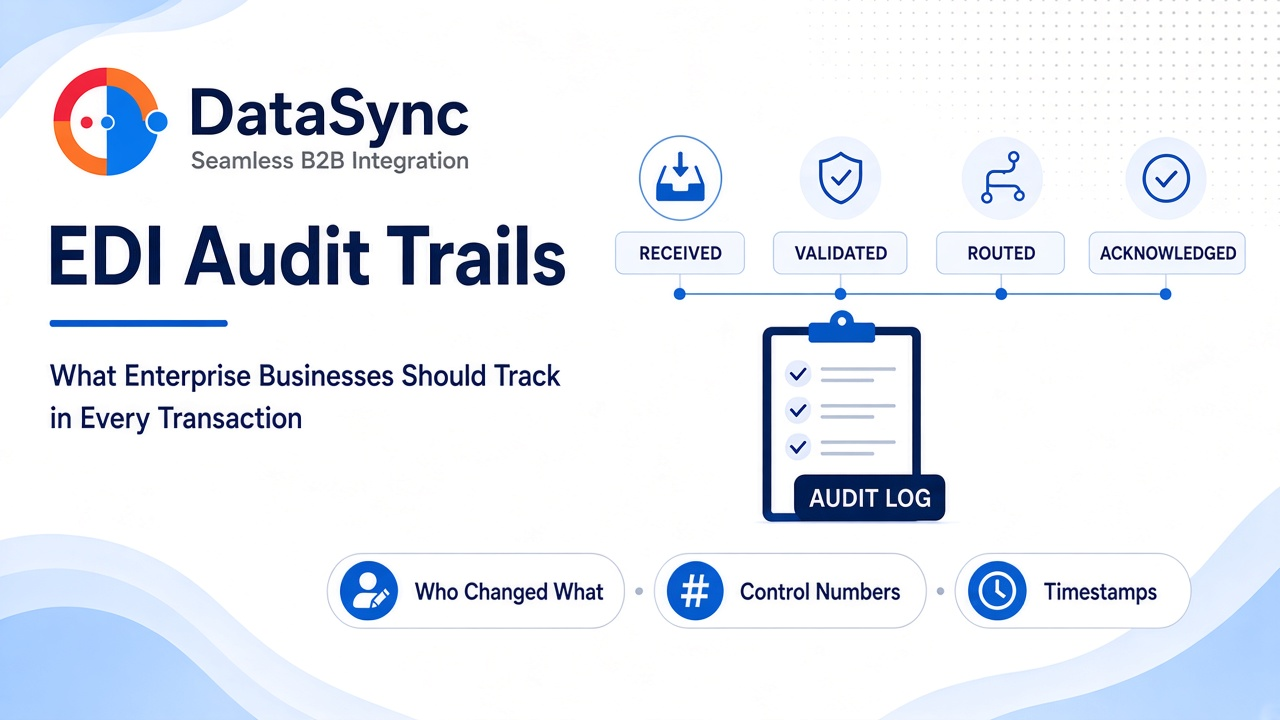
EDI Audit Trails: What Enterprise Businesses Should Track in Every Transaction
- DataSync
- 25 Sep, 2026
- 03 Mins read
- Edi
When a trading partner disputes an order, a payer questions a claim, or finance asks why an invoice posted twice, the argument is rarely about opinion. It is about proof.
An EDI audit trail is the record that shows what arrived, what changed, who acted, and what left—for every transaction, not just the ones that failed.
Start With the Original Payload
The first thing to keep is the file as received.
That means the raw interchange, not only the mapped ERP record. If the original ISA, GS, and ST envelope is gone, you cannot prove what the partner sent or reconstruct a reject.
Store inbound and outbound payloads with timestamps, partner identity, and a pointer that survives reprocessing.
Track Identity, Not Just “A File Came In”
Enterprises need keys they can search months later.
Every transaction record should include:
- Trading partner and environment (test or production)
- Transaction set (850, 810, 856, 837, and others)
- Interchange, group, and transaction control numbers
- Business document IDs such as PO, invoice, shipment, or claim number
- Direction: inbound or outbound
Without those identifiers, audit becomes a mailbox search.
Record Every Status Change
A useful trail is a timeline, not a final status.
Capture when the file was received, validated, mapped, routed, posted, acknowledged, quarantined, or reprocessed. Include the reason code when a step fails.
That history answers the questions ops actually gets: did we accept it, when did ERP see it, and did we already send a 997 or MDN?
Log People and System Actions
Automation does not remove the need for who-did-what.
Track user and system events such as:
- Manual reprocess or replay
- Map or validation-rule changes that affected the file
- Quarantine release or reject decisions
- Partner-notification and case comments
- Certificate or endpoint updates tied to the exchange
If someone can change a transaction without leaving a name, time, and before/after note, the audit trail has a hole.
Keep Acknowledgments in the Same Record
Acknowledgments are part of the transaction, not a side email.
Link the original interchange to its MDN, 997/999, and any application advice (824). Store whether they were sent, received, accepted, or rejected—and when.
When both sides can point to the same acknowledgment chain, disputes shrink and resends drop.
Make Retention and Access Intentional
Keeping everything forever in a shared folder is not an audit program.
Define how long payloads and logs are retained by industry and partner contract. Restrict who can download originals. Make search available to support and compliance without giving everyone production-write access.
The trail only helps if the right people can find it under time pressure.
Final Takeaway
Enterprise EDI audit trails track the original payload, identity keys, status history, human and system actions, and linked acknowledgments for every transaction.
When that record is complete, chargebacks, partner disputes, and compliance reviews become lookups—not reconstructions.
Our Team Members