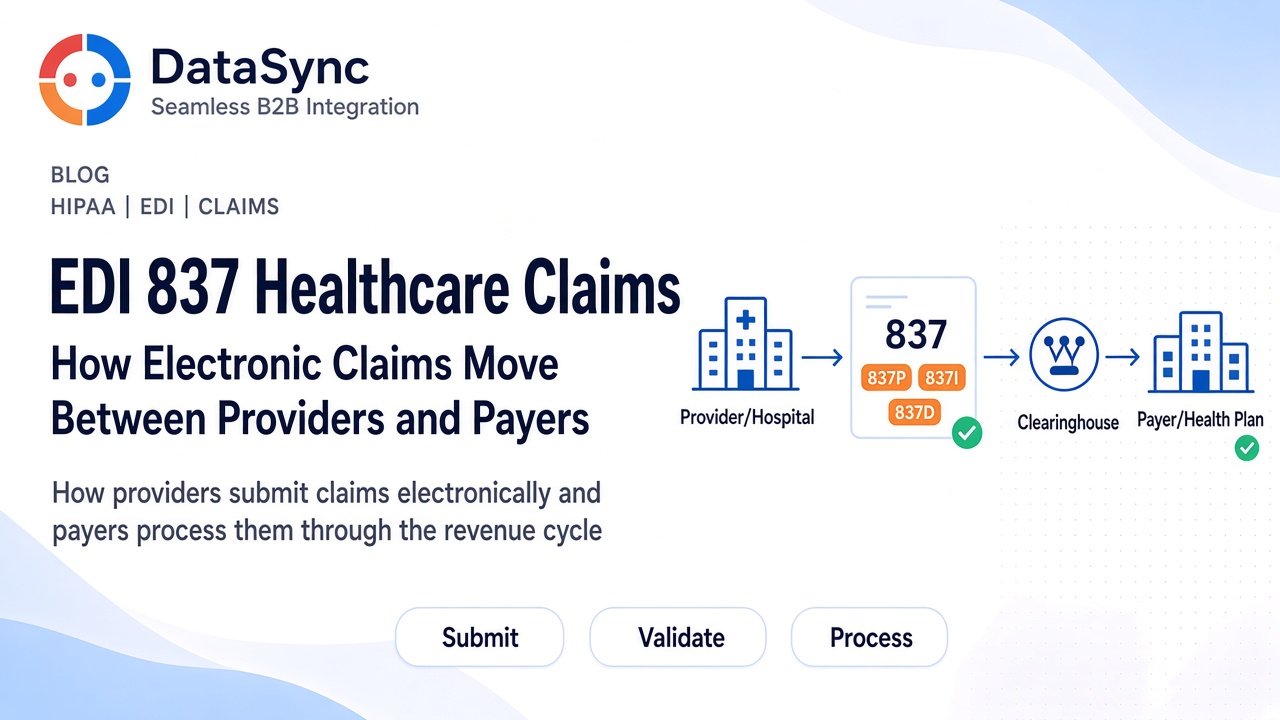
EDI 837 Healthcare Claims: How Electronic Claims Move Between Providers and Payers
- DataSync
- 13 Oct, 2026
- 03 Mins read
- Edi
The EDI 837 is the standard HIPAA transaction used to submit healthcare claims electronically from providers to payers. Instead of paper forms or portal-only entry, the 837 carries structured claim data that payers and clearinghouses can validate, route, and process at scale.
For revenue cycle and EDI teams, understanding how 837 claims move between providers and payers is essential to reducing rejects, speeding payment, and keeping claim status visible.
What an EDI 837 Healthcare Claim Is
An 837 healthcare claim is an X12 transaction set that communicates billing and encounter information to a payer.
It typically includes:
- Patient and subscriber details
- Provider and billing identifiers
- Diagnosis and procedure codes
- Service dates and charge amounts
- Claim-level and line-level supporting data
Once submitted, the claim enters the payer or clearinghouse workflow for structural checks, business validation, adjudication, and later remittance.
The Main 837 Variants
Not every claim uses the same 837 format. Healthcare programs usually work with three common variants.
837P: Professional Claims
837P is used for professional services, such as physician and outpatient provider billing.
837I: Institutional Claims
837I is used for institutional billing, such as hospital and facility claims.
837D: Dental Claims
837D supports dental claim submission where the trading partner requires the dental transaction set.
Choosing the correct variant is one of the first requirements for a clean electronic claim flow.
How Electronic Claims Move From Provider to Payer
A typical EDI 837 path looks like this:
- The provider’s practice management, EHR, or billing system creates claim data.
- Mapping and validation convert that data into an X12 837.
- The claim is sent to a clearinghouse, payer, or both through secure exchange.
- Structural and companion-guide checks accept or reject the file.
- Accepted claims move into payer adjudication.
- Providers later receive claim status and remittance through related transactions such as 277 and 835.
The 837 is the starting point of the electronic claims lifecycle. Everything after it depends on clean submission and clear tracking.
What Happens During Validation
Before a claim can be adjudicated, it must pass technical and business checks.
Common validation layers include:
- X12 syntax and envelope checks
- HIPAA transaction requirements
- Payer companion guide rules
- Provider, member, and code-value validation
- Duplicate or incomplete claim detection
A claim can fail at the EDI layer even when the clinical or billing event was valid. That is why reject monitoring is as important as claim generation.
Why 837 Visibility Matters for Operations
When teams cannot see where an 837 sits in the path, revenue cycle work slows down.
Strong 837 visibility helps teams answer:
- Was the claim generated correctly?
- Did the clearinghouse or payer accept it?
- Was it rejected for mapping, identifier, or code issues?
- Has remittance been returned for this claim?
Without that visibility, providers spend more time chasing status and less time resolving true denials or underpayments.
Best Practices for Reliable 837 Claim Exchange
Healthcare organizations that manage 837s well usually focus on process, not just connectivity.
- Validate against payer companion guides before production volume grows
- Keep provider, member, and coding master data accurate
- Separate technical rejects from business denials in monitoring
- Link each 837 to acknowledgments, status responses, and 835 remittance
- Track repeat reject reasons by payer and claim type
These practices turn electronic claim submission into a controlled operations workflow.
Final Takeaway
EDI 837 healthcare claims are how electronic claims move between providers and payers. Through 837P, 837I, and 837D, providers can submit structured claim data that supports faster processing, clearer validation, and stronger revenue cycle follow-through.
Teams that treat the 837 as an operational process, not only a file format, reduce rejects, improve payer communication, and keep claims moving from submission to payment with fewer preventable delays.
Our Team Members