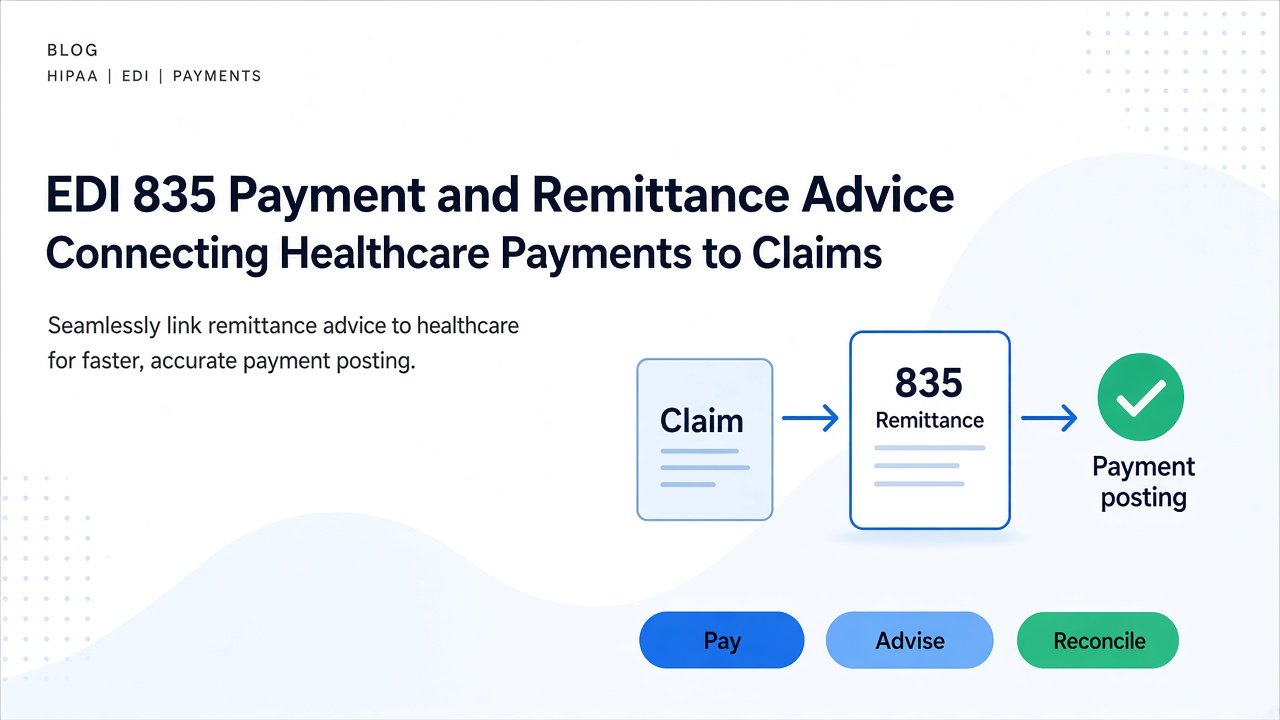
EDI 835 Payment and Remittance Advice: Connecting Healthcare Payments to Claims
- DataSync
- 14 Oct, 2026
- 03 Mins read
- Edi
The EDI 835 Payment and Remittance Advice is how payers tell providers what was paid, adjusted, denied, or left pending on submitted healthcare claims. It connects cash movement to claim detail so finance and revenue cycle teams can post payments accurately.
Without a reliable 835, organizations may receive money but still spend hours matching payments to claims manually.
What an EDI 835 Is Used For
An 835 communicates remittance and payment advice from a payer to a provider or their billing partner.
It typically helps answer:
- Which claims were paid?
- How much was paid at the claim and line level?
- What adjustments or denial reasons applied?
- Which patient responsibility amounts remain?
- How should payment be posted in the billing system?
In practical terms, the 835 is the link between payer adjudication and provider payment posting.
How 835 Connects Payments to Claims
Healthcare payments alone are not enough for clean reconciliation. Teams also need structured remittance detail.
A typical flow looks like this:
- A provider submits an 837 claim.
- The payer adjudicates the claim.
- Payment is issued through ACH, check, or another method.
- An 835 returns claim-level remittance advice.
- The provider posts payment and investigates unpaid or adjusted balances.
The 835 is what makes that last step scalable.
What Remittance Advice Usually Includes
A useful 835 gives operations teams more than a total payment amount.
Common remittance details include:
- Payer and payee identifiers
- Claim control and patient references
- Paid amounts and allowed amounts
- Adjustment reason codes
- Denial or reduction explanations
- Patient responsibility amounts
- Service-line payment breakdowns
That detail is what allows automated posting instead of spreadsheet matching.
Why 835 Processing Matters Operationally
When 835 handling is weak, revenue cycle work slows down even if claims were submitted correctly.
Common problems include:
- Payments arrive without clear claim matching
- Adjustment codes are hard to interpret
- Partial payments create posting errors
- Denial follow-up starts too late
- Finance and billing teams work from incomplete data
Strong 835 processing reduces manual reconciliation and shortens the path from remittance to closed claims.
Best Practices for Managing 835 Remittance
Teams that manage remittance well usually focus on visibility and matching quality.
- Link every 835 back to the original 837 claim references
- Separate full pays, partial pays, adjustments, and denials in reporting
- Monitor unmatched remittance and posting exceptions daily
- Track recurring adjustment reasons by payer
- Keep companion-guide and code interpretation aligned with finance workflows
The goal is not just to receive the 835. The goal is to turn remittance into accurate, timely payment posting.
Final Takeaway
EDI 835 Payment and Remittance Advice connects healthcare payments to claims. It gives providers the structured detail needed to post remittance, understand adjustments, and follow up on unpaid balances.
Organizations that treat the 835 as a core revenue cycle transaction, not just a payment file, reconcile faster and keep claim-to-cash operations under better control.
Our Team Members