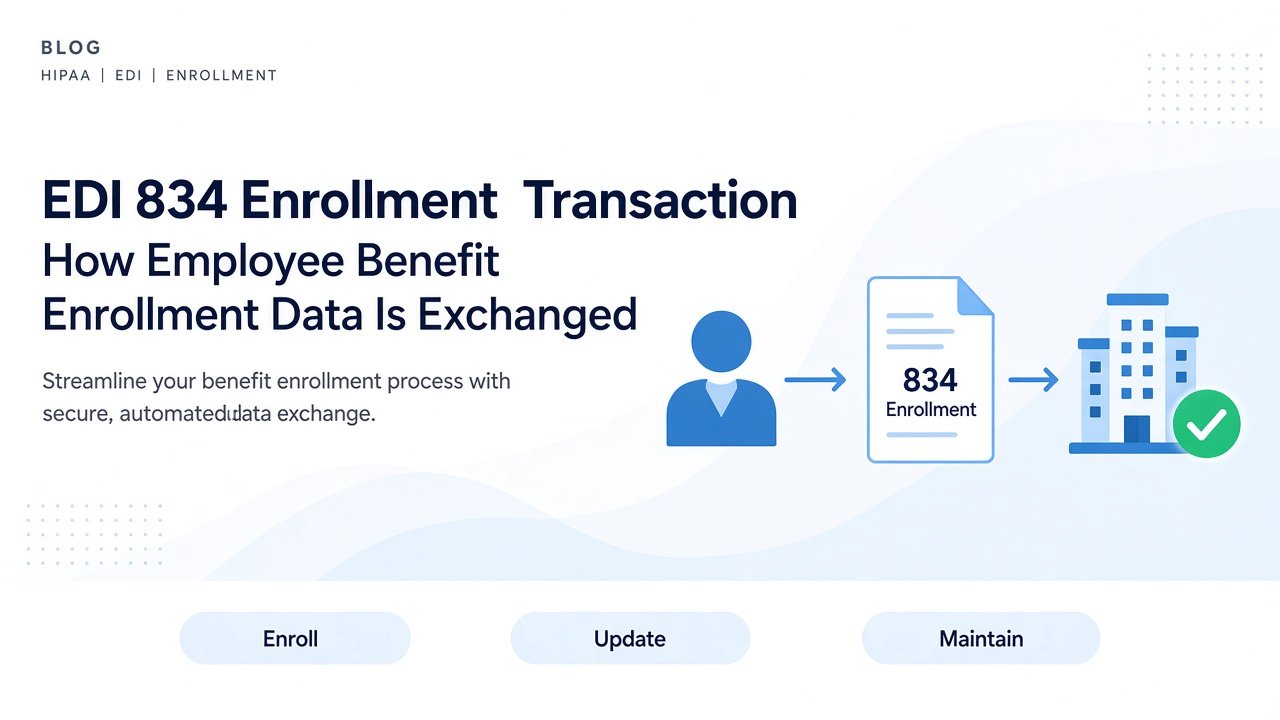
EDI 834 Enrollment Transaction: How Employee Benefit Enrollment Data Is Exchanged
- DataSync
- 16 Oct, 2026
- 03 Mins read
- Edi
The EDI 834 Enrollment Transaction is how employee benefit enrollment and member maintenance data is exchanged electronically between employers, sponsors, payers, and administrators. It is the standard way to communicate who should be added, updated, or removed from a health plan.
For benefits and healthcare operations teams, the 834 is critical because enrollment accuracy affects eligibility checks, claims processing, and member experience downstream.
What an EDI 834 Is Used For
An 834 Benefit Enrollment and Maintenance transaction communicates enrollment-related events.
It is commonly used to:
- Enroll new members
- Update member or dependent details
- Change plan elections
- Process terminations or cancellations
- Maintain ongoing eligibility records
In short, the 834 keeps plan membership synchronized across systems.
How Employee Benefit Enrollment Data Is Exchanged
A typical enrollment exchange looks like this:
- An employer, sponsor, or benefits administrator captures enrollment changes.
- The changes are mapped into an X12 834 transaction.
- The 834 is sent to the payer, TPA, or health plan partner.
- The receiver validates and loads the enrollment updates.
- Downstream eligibility and claims processes use the updated member data.
When this flow is reliable, members are covered correctly and claims start from cleaner eligibility foundations.
What Enrollment Data Usually Includes
An 834 typically carries the demographic and plan information needed to maintain membership.
That can include:
- Subscriber and dependent identifiers
- Demographic details
- Plan and coverage codes
- Enrollment effective dates
- Maintenance reason codes
- Employer or sponsor references
The exact content still depends on partner companion guides and program requirements.
Why 834 Accuracy Matters Downstream
Enrollment errors rarely stay isolated in benefits administration.
Bad 834 data can cause:
- Failed eligibility responses
- Rejected or delayed claims
- Incorrect member coverage status
- Extra call-center volume
- Manual correction cycles between sponsors and payers
That is why enrollment exchange should be treated as an operational control point, not only an HR file transfer.
Common EDI 834 Challenges
Teams often struggle with 834 programs when visibility and validation are weak.
Common issues include:
- Incomplete or mismatched member identifiers
- Late transmission of terminations and updates
- Partner-specific formatting differences
- Unclear error reporting after submission
- Limited reconciliation between sent and accepted enrollments
These problems create gaps between what the sponsor believes was enrolled and what the payer has on file.
Best Practices for Managing 834 Enrollment Exchange
Strong enrollment programs usually include:
- Validation before production transmission
- Clear ownership for add, update, and terminate events
- Monitoring of accepted versus rejected maintenance transactions
- Reconciliation against payer membership records
- Audit-ready history of what was sent and when
The goal is continuous membership accuracy, not just successful file delivery.
Final Takeaway
The EDI 834 enrollment transaction is how employee benefit enrollment data is exchanged across healthcare and benefits partners. It keeps member records current so eligibility and claims processes can operate correctly.
Organizations that manage 834s with strong validation, monitoring, and reconciliation reduce coverage gaps and prevent avoidable downstream revenue cycle issues.
Our Team Members