EDI 824 vs 997/999: How to Read Application Advice and Fix Rejections
- DataSync
- 08 Sep, 2026
- 03 Mins read
- Edi
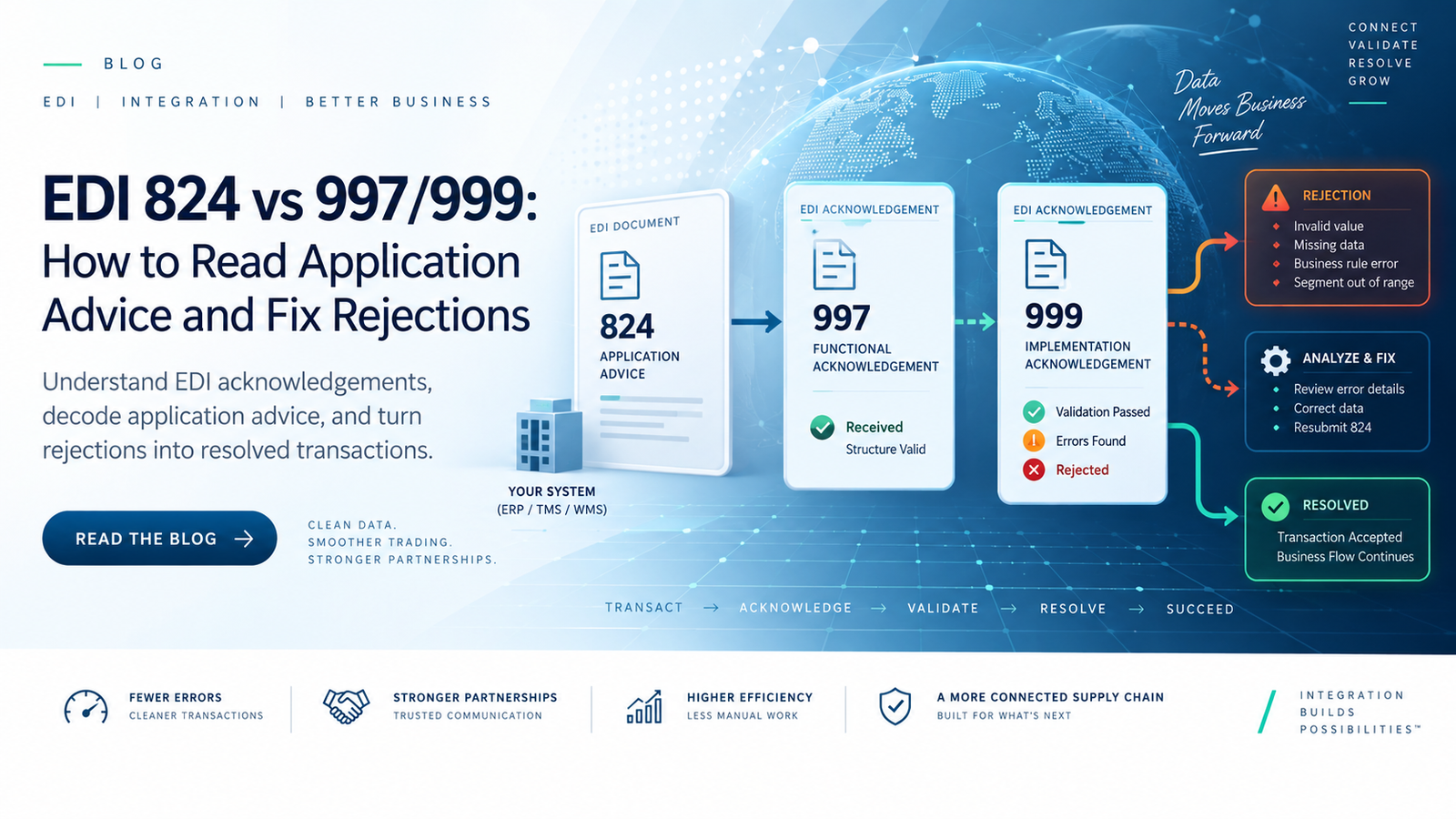
In EDI operations, acknowledgments are not all saying the same thing. A 997 or 999 can tell you whether a document passed structural validation, while an EDI 824 Application Advice usually tells you whether the business application accepted or rejected the document after deeper checks.
That difference matters when teams are trying to understand why an order, invoice, shipment notice, or claim did not move forward.
What Is an EDI 997?
The EDI 997 Functional Acknowledgment confirms whether an ANSI X12 transaction was received and structurally accepted or rejected.
It usually answers questions such as:
- Did the file follow the expected X12 structure?
- Were required segments present?
- Were envelopes and control numbers readable?
- Did the receiver accept or reject the transaction set?
A 997 is mostly focused on syntax and structure. It does not always mean the business system approved the transaction.
What Is an EDI 999?
The EDI 999 Implementation Acknowledgment is similar to the 997, but it is often used when more detailed implementation guide validation is needed.
It can confirm whether a document met specific rules from an implementation guide, such as:
- Required situational segments
- Code values
- Element-level validation
- Partner-specific formatting expectations
In many modern EDI programs, the 999 gives more detailed validation feedback than a traditional 997.
What Is an EDI 824?
The EDI 824 Application Advice communicates business-level acceptance, rejection, or warning information after the document reaches the receiving application.
For example, a purchase order, invoice, or shipment notice may be structurally valid but still fail because:
- A product number is not recognized
- A store or ship-to location is invalid
- A quantity does not match business rules
- A purchase order number cannot be found
- Pricing, tax, or payment details are outside expected tolerances
The EDI 824 helps trading partners understand application-level issues that a 997 or 999 may not catch.
EDI 824 vs 997/999
The easiest way to separate these acknowledgments is by the layer they validate:
- 997 confirms basic X12 receipt and structure
- 999 confirms implementation guide and syntax compliance
- 824 reports business application acceptance, rejection, or warnings
This means a document can receive an accepted 997 or 999 and still receive an 824 rejection later.
Common 824 Rejection Scenarios
Operations teams often see 824s when the EDI file is technically valid but business data does not line up.
Common examples include:
- Invoice references a purchase order that does not exist
- Shipment notice includes an invalid item or case pack
- Purchase order acknowledgment uses a rejected status code
- Healthcare or retail document fails partner business rules
- Duplicate transaction is detected by the receiving application
These issues usually require both EDI context and business process context to resolve.
How to Troubleshoot an EDI 824
When an 824 arrives, start by matching it to the original transaction.
Review:
- Original transaction type and control numbers
- Partner-specific error codes
- Segment and element references in the 824
- Business identifiers such as PO, invoice, shipment, or item numbers
- Whether a 997 or 999 was also returned
If the 997 or 999 was accepted, focus on business data and downstream application rules. If the 997 or 999 was rejected, fix the structural problem first.
Why Monitoring Matters
824 messages are easy to miss if teams only monitor transport delivery or 997 status. A file can be delivered, acknowledged, and still fail the business process.
Strong EDI monitoring should connect:
- AS2 MDN or SFTP delivery status
- 997 or 999 acknowledgment status
- 824 application advice details
- Downstream order, invoice, shipment, or claim status
- Alerts for unresolved rejections
This gives support and operations teams a complete view of where the transaction actually failed.
Final Takeaway
The 997 and 999 help confirm that an EDI document was structurally received and validated. The 824 helps explain whether the receiving business application accepted the document or found a business-rule problem.
For teams managing EDI at scale, tracking all three creates faster troubleshooting, cleaner partner communication, and fewer unresolved transaction failures.
Our Team Members