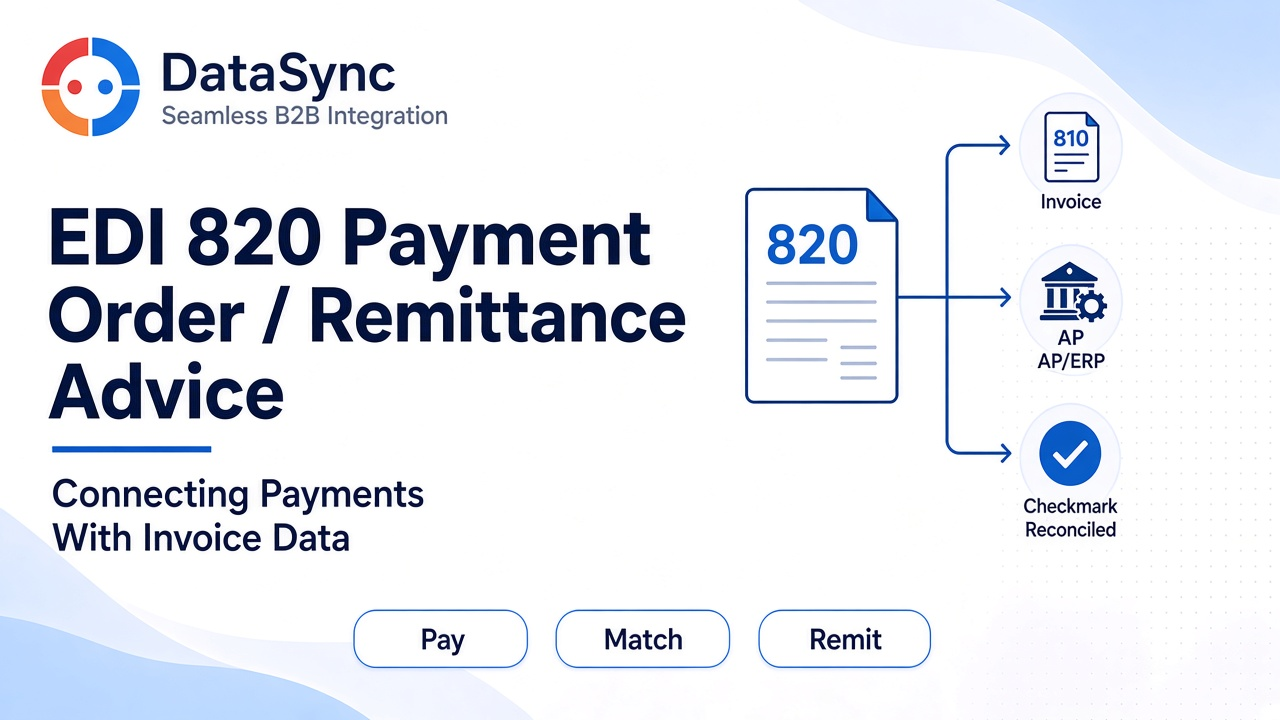
EDI 820 Payment Order/Remittance Advice: Connecting Payments With Invoice Data
- DataSync
- 07 Oct, 2026
- 03 Mins read
- Edi
The EDI 820 Payment Order/Remittance Advice is the electronic document used to communicate payment details and the invoice references those payments settle. It connects cash movement to billing history so accounts receivable and accounts payable share one clear application of funds.
Without remittance detail, finance teams receive money—but still spend hours guessing which invoices were paid.
What Is an EDI 820?
The EDI 820 is an ANSI X12 transaction set that can carry payment order information, remittance advice, or both—depending on the trading partner’s process.
A typical 820 includes:
- Payment amount and payment date
- Payer and payee identifiers
- Payment method or trace references
- Invoice numbers being settled
- Amounts applied to each invoice
- Discounts, adjustments, or short-pay reasons when used
- Related PO or invoice references for reconciliation
In many programs, the bank moves the money while the 820 explains how that money should be applied.
Why Remittance Advice Matters
Payment without remittance creates manual work. Electronic 820s help businesses:
- Auto-apply cash to open invoices
- Reduce unapplied cash and DSO drag
- Clarify short pays, deductions, and discounts
- Improve AR/AP dispute resolution with shared references
- Keep audit trails from invoice to settlement
For high-volume suppliers, remittance quality often matters as much as payment speed.
How Payments Connect to Invoice Data
A common automated flow looks like this:
- Supplier sends an EDI 810 invoice for shipped or delivered goods.
- Buyer AP matches the invoice to PO and receipt/ASN data.
- Payment is scheduled under agreed terms.
- EDI 820 remittance lists which invoices (and amounts) the payment covers.
- Supplier AR applies cash using invoice references from the 820.
- Exceptions are worked—missing invoices, deductions, or amount mismatches.
The 820 is the bridge between “funds received” and “invoice closed.”
Key Data Teams Should Watch on Every 820
Finance and EDI teams usually focus on:
- Invoice correlation — remittance lines match real open invoices
- Amount application — paid amounts, discounts, and adjustments reconcile to totals
- Trace numbers — payment references support bank and ERP matching
- Deduction clarity — short-pay reason codes are explicit when used
- Timing — remittance arrives close enough to payment to avoid unapplied cash
- Duplicate protection — same remittance or payment not applied twice
A payment total without invoice-level detail is only half the document.
How the 820 Connects to 810 and the Order Chain
- 850 / 855 / 856 establish what was ordered, confirmed, and shipped
- 810 requests payment for the commercial result
- 820 reports how payment was applied back to those invoices
Clean order-to-cash programs keep PO, invoice, and remittance references linked end to end.
Common EDI 820 Problems
Teams frequently see:
- Payments posted with weak or missing invoice references
- Remittance totals that do not equal the payment amount
- Deductions without usable reason detail
- One payment covering many invoices with incomplete line breakdown
- Timing gaps that leave cash unapplied for days
- Partner-specific adjustment codes that maps do not handle
Validate remittance structure before apply—and age unapplied cash with ownership.
Final Takeaway
The EDI 820 Payment Order/Remittance Advice connects payments with invoice data. When remittance detail is complete, timely, and matched to open 810s, cash application becomes a controlled workflow instead of a spreadsheet exercise.
If your team still receives ACH or wires without structured remittance, the payment arrived—but the reconciliation work did not go away.
Our Team Members