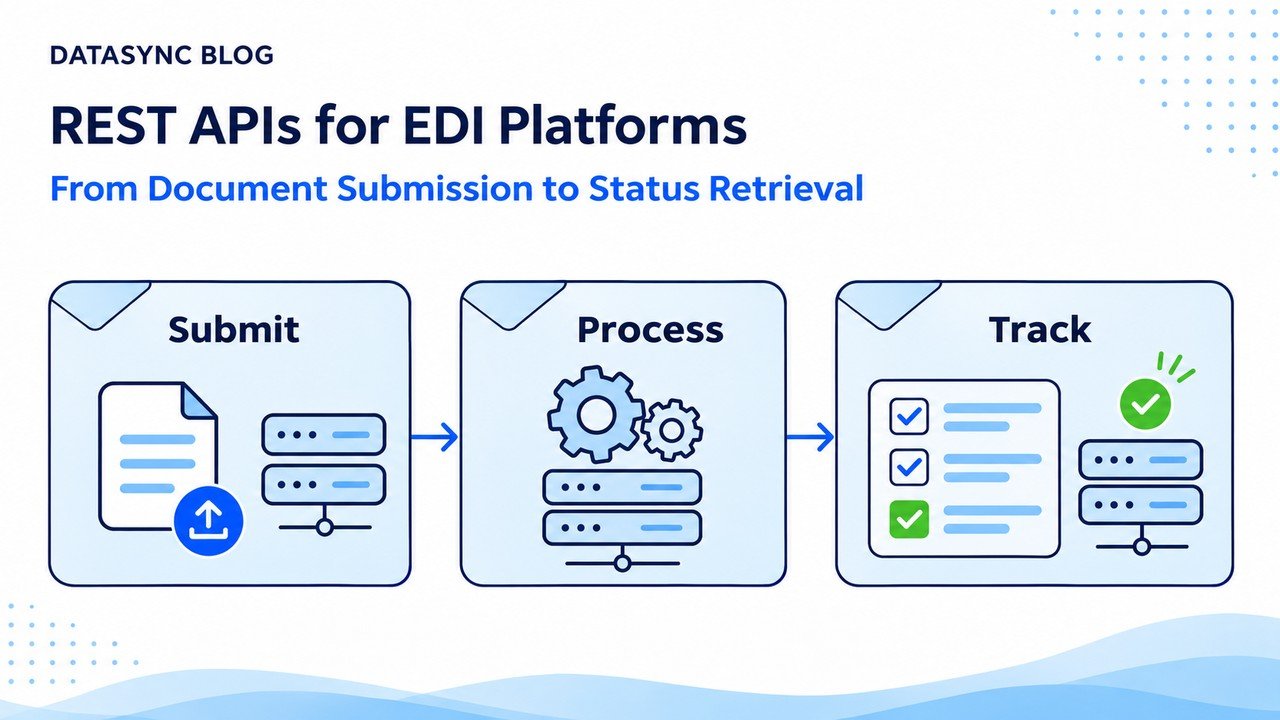
Designing REST APIs for EDI Platforms: From Document Submission to Status Retrieval
- DataSync
- 27 Nov, 2026
- 03 Mins read
- Edi
REST APIs for EDI platforms should give applications a clear way to submit documents and understand what happened afterward. Accepting an API request, translating a payload, delivering it to a partner, and obtaining business acceptance are different outcomes.
A useful API exposes those distinctions while making retries and status retrieval predictable.
What Counts as an EDI API Contract
The contract describes the accepted input, caller permissions, processing behavior, and observable results. It should let a client recover from uncertainty without creating duplicate business documents.
Define these details explicitly:
- Authentication and tenant authorization
- Partner, document type, and environment selection
- Raw EDI or structured input formats
- Submission references and idempotency behavior
- Validation errors and asynchronous processing states
- Status retrieval, notifications, and retention
Keep partner-facing envelope control numbers available for investigation, but also provide an API resource identifier that remains stable throughout the submission’s processing history.
Three Resources to Design Clearly
Document Submission
An illustrative endpoint such as POST /documents can accept a supported document and return a stable identifier. Validate access and the request contract before queuing work. Document what is checked immediately and what can fail after acceptance.
Processing Status
An illustrative GET /documents/{id} should report the current processing stage and available outcomes. For work performed asynchronously, a 202 Accepted response can point to a status resource. Microsoft’s asynchronous request-reply pattern explains this approach and polling guidance.
Events and Evidence
Expose relevant validation results, delivery attempts, and acknowledgment references. If webhooks are supported, define authentication, retries, event identifiers, and ordering expectations. Clients should be able to reconcile notifications against authoritative stored status.
Signals the API Contract Is Ambiguous
Review the design when:
- A successful HTTP response is displayed as partner acceptance
- Clients submit again because the first request timed out
- Error responses omit a useful field or rule reference
- Status values mix transport and application outcomes
- A caller can retrieve another tenant’s document by ID
- Notifications cannot be reconciled after an interruption
An API that returns an identifier but loses the request before durable acceptance creates uncertainty at the first step. Align response behavior with the platform’s actual persistence guarantees.
How to Design a Recoverable Submission Flow
Use a documented lifecycle:
- Authenticate the caller and authorize the target context
- Validate request format and required submission metadata
- Apply the agreed idempotency contract and persist accepted work
- Return the submission identifier and status location
- Record validation, transformation, delivery, and acknowledgment results
- Expose status and evidence for authorized polling or notification clients
For example, define how a tenant-scoped idempotency key behaves when a client retries the same request after a timeout. State the retention window and the response to a reused key with different content. This is an API design decision, not an automatic property of every POST endpoint.
What Reliable Status Retrieval Should Mean
The API should provide:
- Explicit stage names and documented transitions
- Stable error codes with actionable details
- Timestamps and correlation references
- Authorized access to payloads and evidence
- Pagination and bounded status-query behavior
- Documented treatment of unknown, expired, and incomplete records
A failed delivery attempt may be followed by a successful retry. Preserve the attempt history so the current status does not erase the explanation of what happened.
A Simple API Readiness Test
Ask four questions from the client’s perspective:
- Can we safely resolve an uncertain submission outcome?
- Can we distinguish API acceptance from partner processing?
- Can we identify and correct a rejected input?
- Can we retrieve only the resources we are authorized to access?
Exercise those questions with timeouts and rejected documents as well as the ordinary successful call.
Final Takeaway
EDI APIs work best when submission, processing, and evidence are clear resources with a documented lifecycle. Reliable retries and authorized status retrieval are central parts of that contract.
Design the interface around the outcomes client applications actually need to explain.
Our Team Members