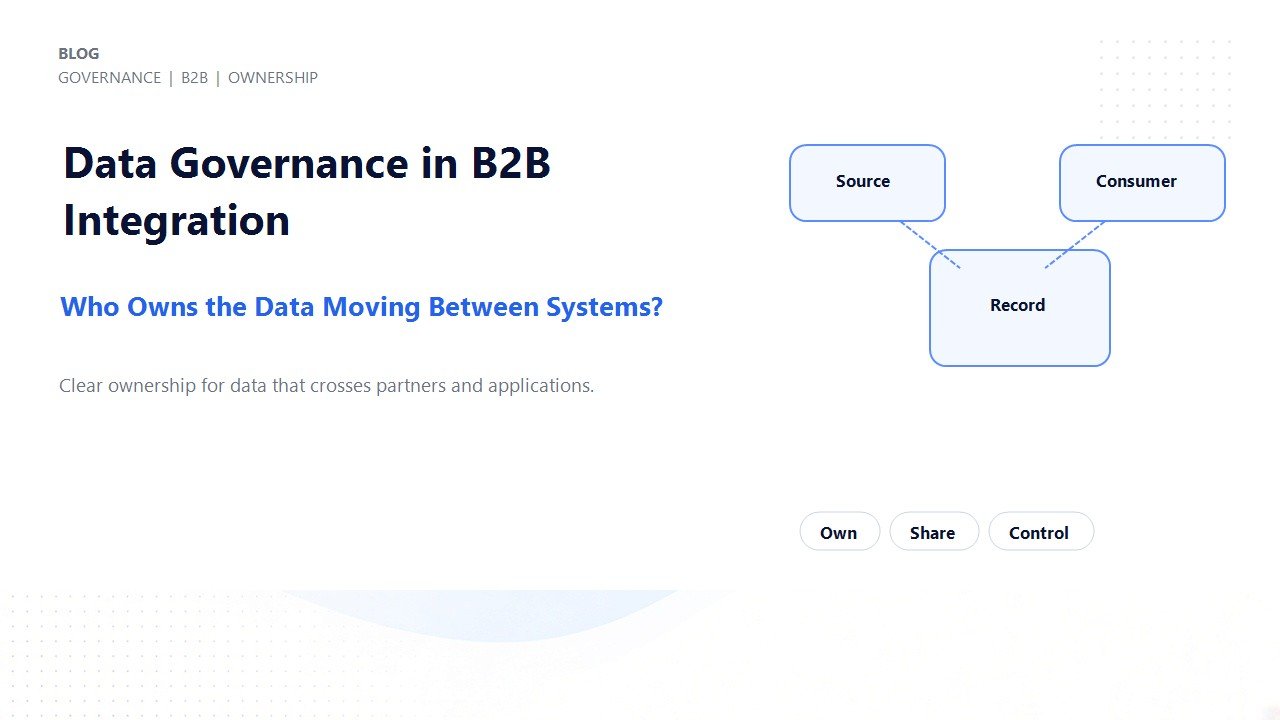
Data Governance in B2B Integration: Who Owns the Data Moving Between Systems?
- DataSync
- 30 Oct, 2026
- 03 Mins read
- Edi
Data governance in B2B integration answers a simple operational question: when a purchase order, invoice, shipment notice, or claim moves between systems, who is accountable for its meaning and quality?
If nobody owns that answer, mapping debates, partner disputes, and repeated exceptions have no place to land.
Why Ownership Gets Blurry
B2B data does not live in one application. A partner creates it, an integration layer transforms it, and an internal system posts it.
Each team can claim a piece:
- The partner owns what they sent
- The integration team owns the map
- The business system owns the posted record
- Operations owns the exception queue
All of those can be true, and the transaction can still fail because no one owns the business definition. “Ship-to,” “unit price,” or “member ID” means something specific. Someone has to decide which meaning is authoritative.
The Roles That Need to Be Named
Governance does not require a new department. It requires named roles for data in motion.
Source
The source is the system or partner that creates the business fact. They are accountable for sending complete, agreed values.
Steward
The steward owns the definition used inside the enterprise: which code set, which identifier, and which tolerance is acceptable. This is usually a business owner for that document family, not the integration platform alone.
Consumer
The consumer is the system that posts or acts on the data. They are accountable for rejecting what they cannot process and for not silently changing meaning.
The integration layer enforces those decisions. It should not invent them during an incident.
What Governance Covers in Practice
For B2B flows, useful governance is concrete:
- Which identifier matches a partner, item, location, or member
- Which document is the system of record after posting
- Which fields may be defaulted, and by whom
- How long the original payload and the mapped version are retained
- Who approves a map change that alters business meaning
- How a partner-specific exception becomes a rule instead of a one-time fix
If those points are undocumented, every new partner reopens the same argument.
What Happens Without an Owner
Unowned data shows up as operational noise:
- The same rejection is “fixed” differently each time
- Master data and maps disagree
- Audit questions cannot be answered from the posted record alone
- A partner change is applied in one flow and missed in another
- Teams escalate defects that are really definition gaps
The integration did its job. The business rule was never assigned.
A Lightweight Governance Model
Enterprises do not need a policy binder before they can start. They need a short record for each major document type:
- Business owner
- System of record
- Required identifiers
- Validation rules that can stop posting
- Who approves map and code-set changes
- Retention of the original transaction
Review it when a partner is onboarded or a rule starts failing often. That is enough to keep ownership visible.
Final Takeaway
Data governance in B2B integration is about who owns the data moving between systems, not only who runs the interface. Source, steward, and consumer roles keep partner files, maps, and posted records aligned.
When those roles are named, exceptions have an owner, map changes have an approver, and the business meaning of an order or invoice survives the trip between systems.
Our Team Members