Data Encryption in Transit and at Rest: What Enterprises Should Know About Integration Security
- DataSync
- 03 Nov, 2026
- 03 Mins read
- Edi
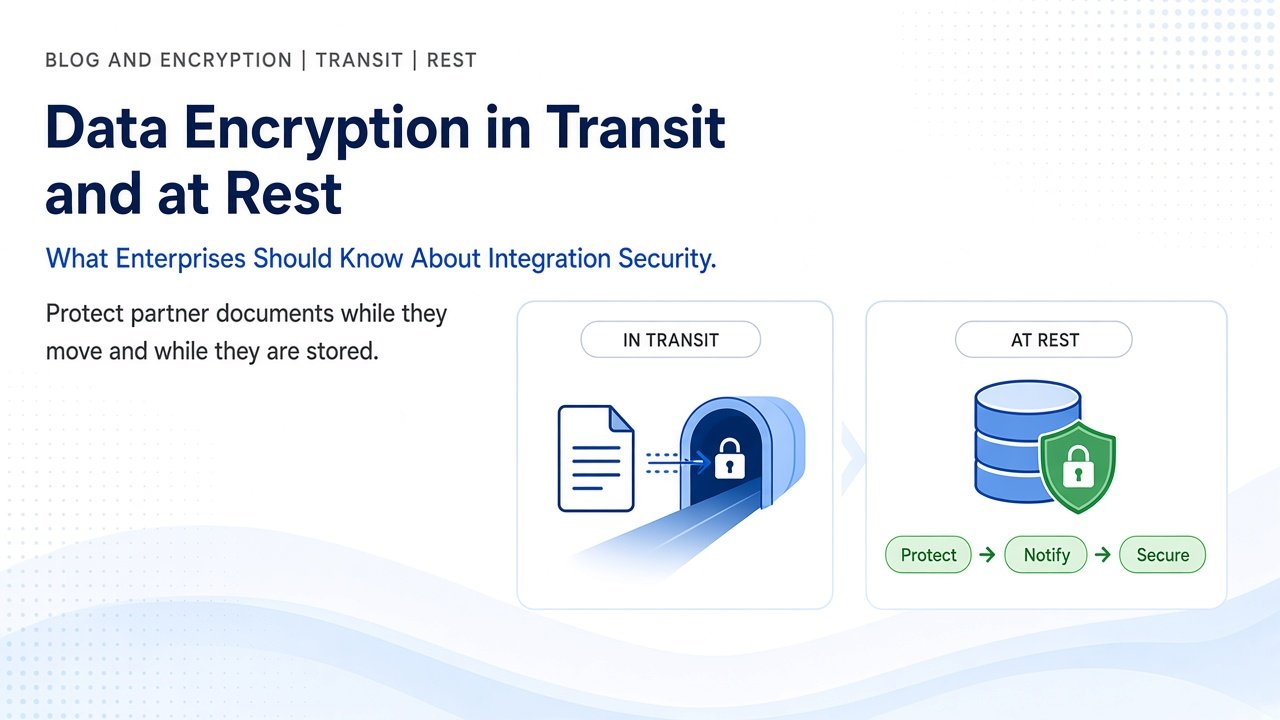
Encryption in transit protects a document while it is moving. Encryption at rest protects it while it is stored. Integration platforms need both, because partner files do not only travel across a network. They also land in queues, archives, error folders, and support tools.
Enterprises that secure only the connection still leave readable copies in places an attacker or an over-permissioned user can reach.
What Encryption in Transit Covers
In-transit encryption protects data between two endpoints.
In B2B integration that usually means:
- TLS for APIs and webhooks
- AS2 with signed and encrypted payloads
- SFTP instead of plain FTP
- Encrypted email or managed file channels where partners still require them
The goal is simple: a document intercepted on the wire should not be usable.
Transit encryption fails in practice when teams allow fallback to older protocols, skip certificate validation, or terminate TLS so early that the remaining hop is plain text.
What Encryption at Rest Covers
At-rest encryption protects stored copies.
That includes:
- Message queues and staging areas
- Partner archives and audit storage
- Database fields that hold payload content
- Backups and exported support packages
- Temporary files created during mapping or reprocessing
If a disk, snapshot, or backup is taken, the stored documents should still be protected by encryption and access control.
Why Integration Platforms Are a Special Case
An order or invoice may exist in several forms inside one flow:
- The original partner file
- The mapped internal format
- A failed copy held for exception review
- An archive kept for audit or dispute handling
Encrypting only the AS2 session is not enough if the archive is readable to anyone with file access. Encrypting only the archive is not enough if the file crosses an unprotected hop.
Both states matter.
Keys, Certificates, and Operational Reality
Encryption is only as strong as key handling.
Enterprises should be clear on:
- Who can create, rotate, and revoke certificates or keys
- How private keys are stored and who can export them
- When partner certificates expire
- Whether test and production keys are separated
- How a lost or compromised key is replaced without long downtime
A perfect algorithm with a shared private key on a shared drive is not a strong design.
What Teams Often Miss
Common gaps show up outside the “happy path” connection:
- Error mailboxes with unencrypted attachments
- Support downloads of original payloads
- Logs that print sensitive fields in clear text
- Older SFTP servers still accepting weak ciphers
- Archive retention that never reviewed who can read old files
Security reviews that stop at “we use AS2” miss those stores and side channels.
A Practical Checklist
- Prefer encrypted protocols for every partner and internal hop
- Encrypt stored payloads, not only the network path
- Limit who can decrypt or download originals
- Rotate certificates before they expire
- Keep an inventory of where copies of a document can live
- Test restore and reprocess paths without weakening encryption
Final Takeaway
Encryption in transit and at rest is core integration security, not a checkbox for the network team alone. Documents must stay protected while they move between partners and while they wait in queues, archives, and exception stores.
Enterprises that design for both states reduce the chance that a stolen file, backup, or support export becomes a business incident.
Our Team Members