Common Enterprise Integration Patterns: Request-Reply, Publish-Subscribe, and More
- DataSync
- 26 Oct, 2026
- 03 Mins read
- Edi
Enterprise integration patterns are repeatable ways systems exchange data. Request-reply, publish-subscribe, and a handful of related patterns cover most B2B and internal flows. Choosing the right one keeps ownership, timing, and failure handling clear as the landscape grows.
The pattern is not a product feature. It is the shape of the conversation between systems.
Request-Reply
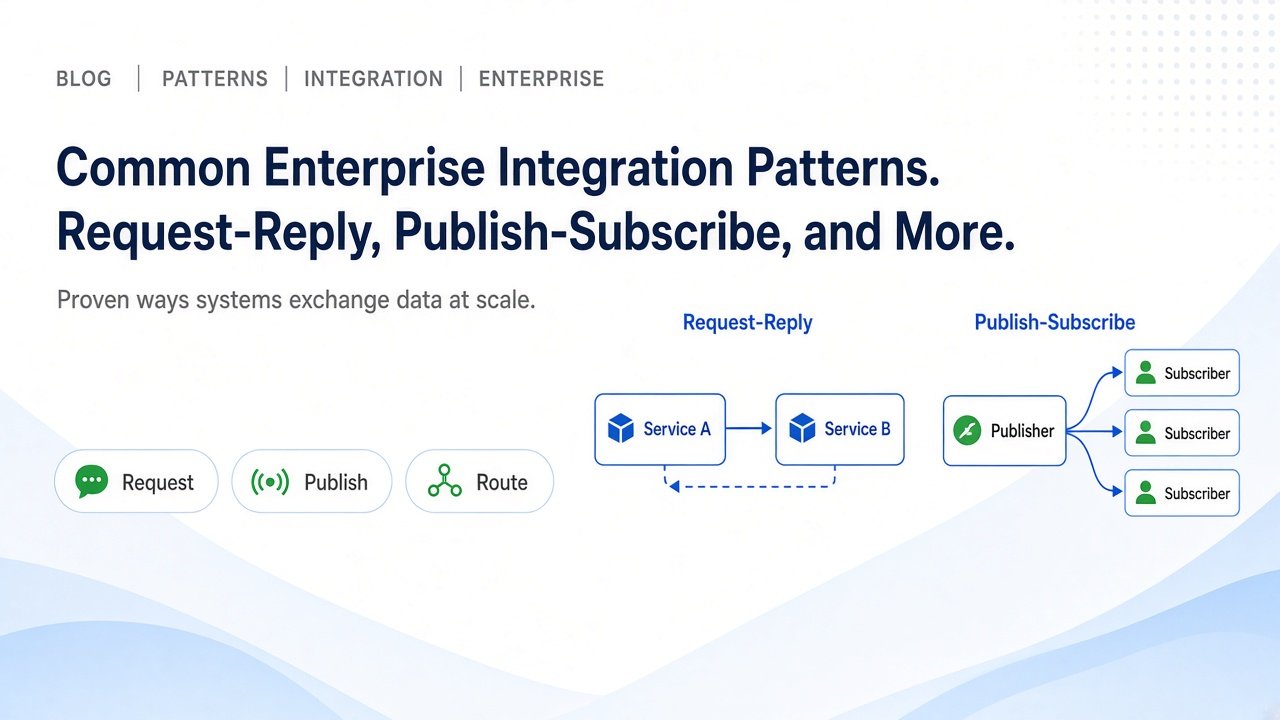
In request-reply, one system asks and waits for an answer.
Eligibility checks, price lookups, and claim status inquiries often work this way. The caller needs the response before the next business step can continue.
It fits when:
- The answer is required immediately
- There is one clear responder
- The caller can handle a timeout or error
It fits poorly when many systems need the same update, or when the caller should not stall if the responder is slow.
Publish-Subscribe
In publish-subscribe, a publisher emits an event and any number of subscribers react.
An accepted order might notify fulfillment, finance, and a customer portal without the order system calling each one. Subscribers stay independent. The publisher does not need a new connection every time another team wants the event.
It fits when:
- Several systems care about the same fact
- Receivers can process at their own pace
- You want to add consumers without changing the producer
It needs retention and replay, or a subscriber that was down will miss the update.
Fire-and-Forget
Fire-and-forget sends a message and does not wait for a business reply.
It is useful for notifications and downstream handoffs where the sender’s job ends at successful handoff to the integration layer. It is a poor fit when the business step is incomplete until the receiver confirms acceptance.
Teams should still track delivery. “Forget” means the sender does not block. It does not mean operations ignore failure.
Content-Based Routing
Routing sends a message to different destinations based on partner, document type, or content.
An EDI platform uses this constantly: an 850 goes to order management, an 810 goes to accounts payable, and a partner-specific variant uses a different map. The sender does not choose the internal destination. The integration layer does.
Routing scales better than hard-coding destinations inside every source system.
Splitter, Aggregator, and Correlation
Some exchanges do not stay one-message-to-one-message.
- A splitter breaks a batch file into individual transactions
- An aggregator collects line items or related messages into one business document
- Correlation ties a response, acknowledgment, or remittance back to the original transaction
EDI programs rely on these patterns whenever a file contains many documents or a later 997, 824, or 835 must be matched to the source.
How to Pick a Pattern
Match the pattern to the business question:
- Do you need an answer now? Use request-reply.
- Do many systems need the same change? Use publish-subscribe.
- Is handoff enough? Use fire-and-forget, with delivery tracking.
- Does destination depend on partner or document type? Use routing.
- Must a later message be tied to an earlier one? Use correlation.
Mixing them is normal. A partner file can be split, routed, and then published internally as events.
Final Takeaway
Request-reply, publish-subscribe, routing, and correlation are the patterns enterprises use to move business data without inventing a new design for every flow. The right pattern depends on whether you need an immediate answer, a fan-out, a handoff, or a link back to the original document.
Teams that name the pattern up front also name the failure mode: timeouts, missed subscribers, duplicate delivery, or unmatched responses. That is what makes the integration operable at scale.
Our Team Members