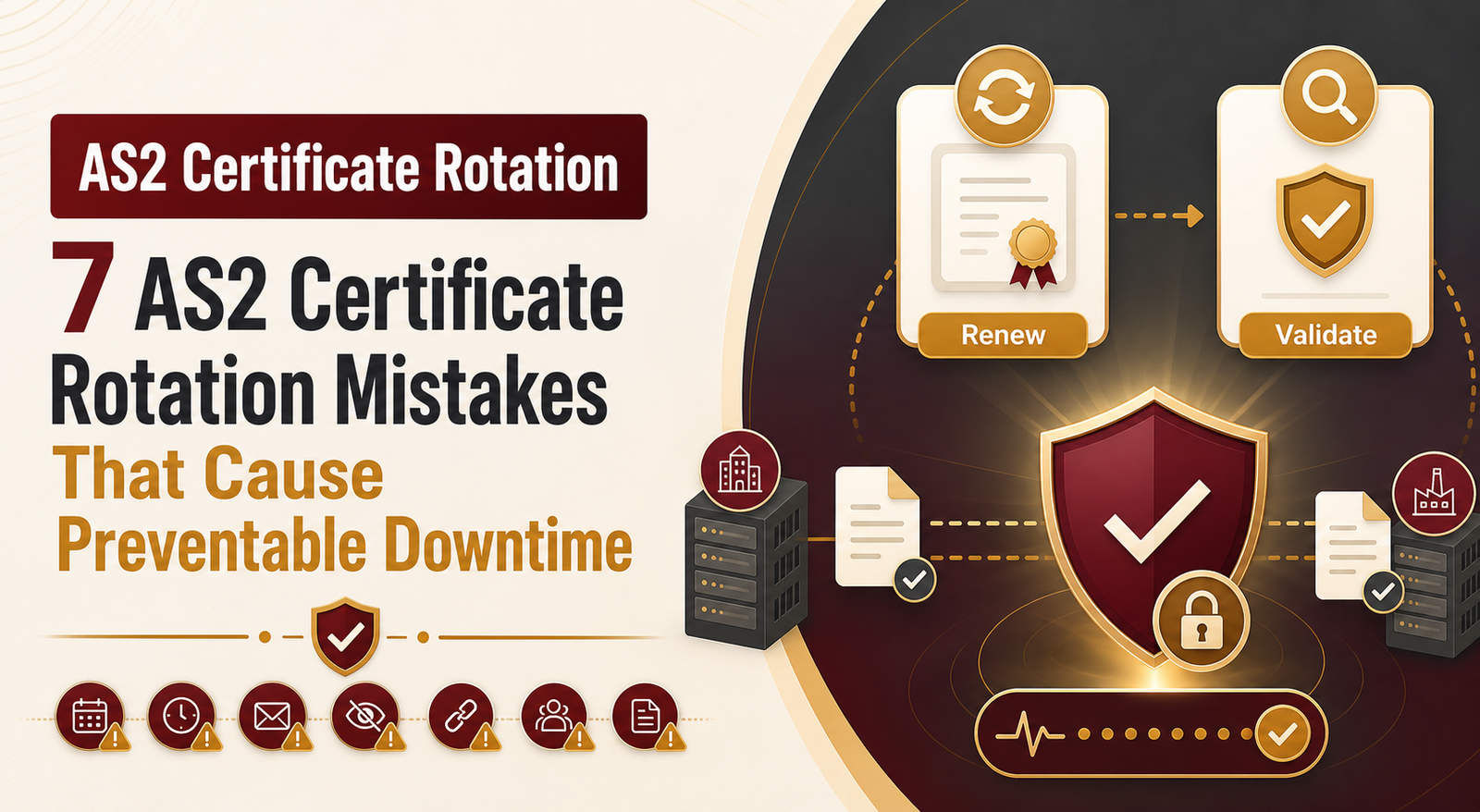
7 AS2 Certificate Rotation Mistakes That Cause Preventable Downtime
- DataSync
- 26 Aug, 2026
- 03 Mins read
- Edi
AS2 certificate rotation should be routine maintenance, not an outage event. Yet many EDI teams still experience preventable downtime because certificate changes are handled too late, tested too lightly, or communicated too poorly across trading partner relationships.
If your team depends on AS2 for EDI, these are the most common certificate rotation mistakes to avoid.
1. Waiting Until the Certificate Is About to Expire
The most common AS2 certificate rotation mistake is starting too late.
Many teams notice an expiring certificate only days before the cutoff. That leaves almost no time for partner communication, endpoint updates, validation, and issue resolution. If even one trading partner misses the change, production traffic can fail immediately after expiration.
A safer approach is to begin rotation planning at least 30 to 60 days in advance for critical partners.
2. Updating Your System but Not the Trading Partner
AS2 certificate rotation is never only an internal task.
Your environment may be fully updated, but if the trading partner has not imported the new public certificate or mapped it to the right AS2 identity, messages can start failing. In many cases, teams assume the partner completed the update when they only acknowledged the email.
Rotation should always include explicit partner confirmation, not just outbound notification.
3. Forgetting About Both Directions of Traffic
Some teams focus only on outbound AS2 message signing or encryption and forget that inbound traffic may also depend on certificate trust configuration.
That creates a dangerous gap. You may be able to send messages successfully while inbound messages, MDNs, or acknowledgments begin failing. The result is partial downtime that is harder to detect than a full stop.
Every certificate rotation plan should confirm the impact on:
- Outbound EDI messages
- Inbound EDI messages
- Synchronous or asynchronous MDNs
- Encryption and signature validation
4. Skipping End-to-End Testing with Real Partners
Internal testing is helpful, but it is rarely enough on its own.
AS2 certificate rotation problems often appear only in real partner exchanges where certificates, identifiers, endpoints, and MDN expectations all interact. If you rotate certificates without full end-to-end testing, production becomes the test environment.
At minimum, teams should validate a controlled send-and-acknowledge cycle with key partners before the cutover date.
5. Overlooking MDN Failures After the Rotation
Many teams treat a successful AS2 send as proof that rotation worked. That is not always true.
If the partner receives the message but MDNs fail because of trust, signing, or partner-side validation issues, your team may lose delivery visibility even when payload exchange appears normal. That can trigger disputes over whether a transaction was truly delivered.
After certificate rotation, monitoring should confirm not only message delivery but also expected MDN behavior.
6. Rotating Without a Rollback Plan
Certificate changes can fail for reasons outside your control, including partner misconfiguration, outdated trust stores, or undocumented dependencies in older integrations.
If there is no rollback path, even a small issue can stretch into a long outage window. Teams should know in advance whether they can temporarily revert to the prior certificate, how long overlap can be supported, and who is authorized to make that call.
Good rotation planning includes both a cutover plan and a recovery plan.
7. Managing Certificate Rotation Manually with Poor Tracking
Spreadsheets and scattered emails are one of the biggest causes of preventable AS2 downtime.
When ownership, dates, partner confirmations, test status, and deployment steps are spread across inboxes, teams miss deadlines and make avoidable mistakes. This becomes even riskier when dozens or hundreds of trading partners are involved.
Operations teams should track:
- Certificate expiration dates
- Partner notification status
- Testing completion
- Cutover dates
- Post-rotation validation results
Final Takeaway
The biggest AS2 certificate rotation mistakes are rarely technical edge cases. Most preventable downtime comes from late planning, incomplete partner coordination, weak testing, poor MDN monitoring, and missing rollback procedures.
If your EDI program relies on AS2, certificate rotation should be treated like a controlled operational change, not a last-minute admin task. Teams that build a repeatable process reduce downtime risk and protect trading partner trust.
Our Team Members